BRM P351 Restoration: From Prototype to Track Ready
British Racing Motors has never been just a name from the past. It’s a piece of British motorsport’s DNA. Born in 1949 from the ambition of Raymond Mays and Peter Berthon, BRM became the country’s first Formula 1 team, took its first F1 start in 1951, and reached the summit in 1962 when Graham Hill delivered both the Constructors’ and Drivers’ titles.
But BRM always wanted more than Grand Prix glory. It wanted to go long.
A Lost Le Mans Dream
In the early 1990s, that hunger produced one of the most intriguing “what if” machines in endurance racing: the BRM P351.
Built as a Group C sports prototype, the one-off car was designed to take on the World Sportscar Championship and, above all, the 24 Hours of Le Mans in 1992. It arrived with serious intent: a carbon-composite monocoque, a closed cockpit, and an in-house naturally aspirated 3.5‑litre V12 sitting at its heart.
On paper, it had everything it needed to make a mark. On track, it had the speed to match the era’s giants. The P351 clocked 216 mph (348 kph) down the Mulsanne Straight at Le Mans, right in the same ballpark as the Peugeot and Toyota contenders of the time.
Then it broke.
Transmission trouble forced an early retirement, the car’s Le Mans bid cut short before it could build a legend. The P351 later appeared at Silverstone, but its story soon splintered.
From Prototype to P301 – And Back Again
As endurance racing evolved, so did the car. BRM’s pure V12 concept gave way to a different life. In the latter half of the 1990s, the original machine was reworked: the roof came off, the car was opened up, and a Nissan twin‑turbo V6 replaced the BRM-built V12. Under Pacific Racing, the reimagined car ran as the BRM P301, a very different beast from the factory prototype that had thundered down the Mulsanne.
Somewhere along that winding path, the original spirit of the P351 seemed to disappear into the paddock shadows.
Then it came home.
Late in 2024, the car found its way back into BRM’s hands. What followed wasn’t a cosmetic refresh or a museum polish. It was a full-scale resurrection.
Resurrection at Silverstone
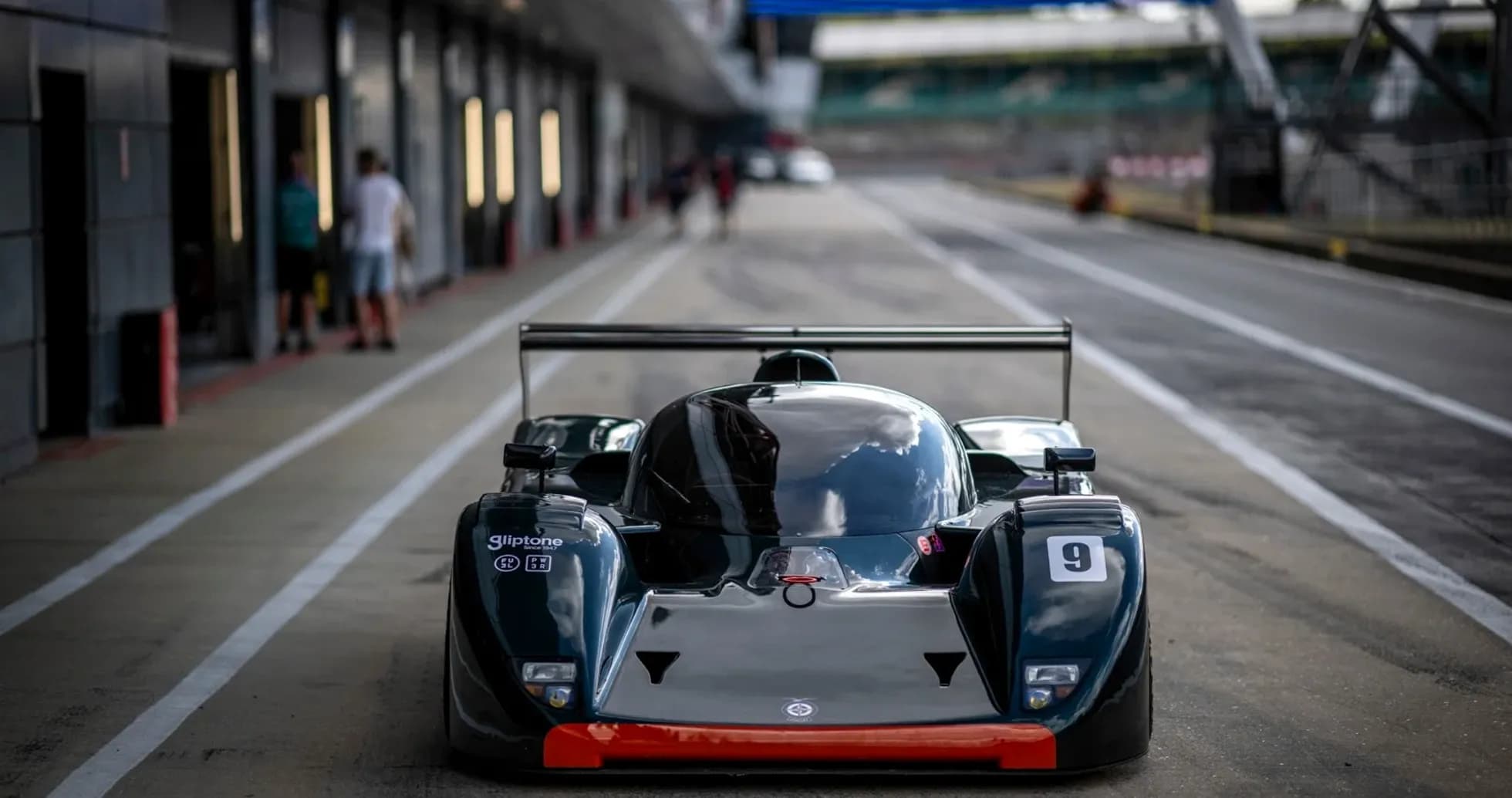
The restoration is now complete, and this past weekend the P351 re-emerged at Silverstone in the form BRM always intended: closed cockpit, carbon-composite monocoque, and its own naturally aspirated 3.5‑litre V12 back in place.
The roof – once cut away in the P301 era – has been painstakingly recreated. BRM turned to surviving original documents and period photography to reverse-engineer the structure, rebuilding the car’s silhouette with forensic care rather than guesswork.
Underneath, the work runs even deeper. The V12 and transmission have been completely rebuilt by Dawson Racing, returning the car to its native specification but with modern reliability in mind. The P351 now runs on sustainable fuel, a neat collision of heritage and present-day responsibility.
This is not a static tribute. BRM is not parking the P351 under soft lighting and a velvet rope.
Built to Race Again
The team intends to put the car back into competition. The exact series and events remain under wraps, but the plan is clear: the restored P351 will race, not just demonstrate. It will run with its original concept – BRM engine, BRM identity – updated only where necessary to meet today’s demands.
The project has drawn in heavyweight support. Companies including Motul, Goodyear, and SKF Automotive have all played their part in the revival, helping to return the car to a standard fit for serious track action rather than nostalgic parade laps.
So the one-off that once flashed to 216 mph at Le Mans, only to vanish into obscurity and modification, is back in its original skin and ready to work again.
The next question is simple, and far more compelling than any museum plaque: when the P351 finally lines up on a modern grid, can it turn unfinished business into a legacy worthy of its badge?