.svg&w=384&q=75 "logo")
Briatore Challenges FIA Verdict on Gasly’s Monaco Podium
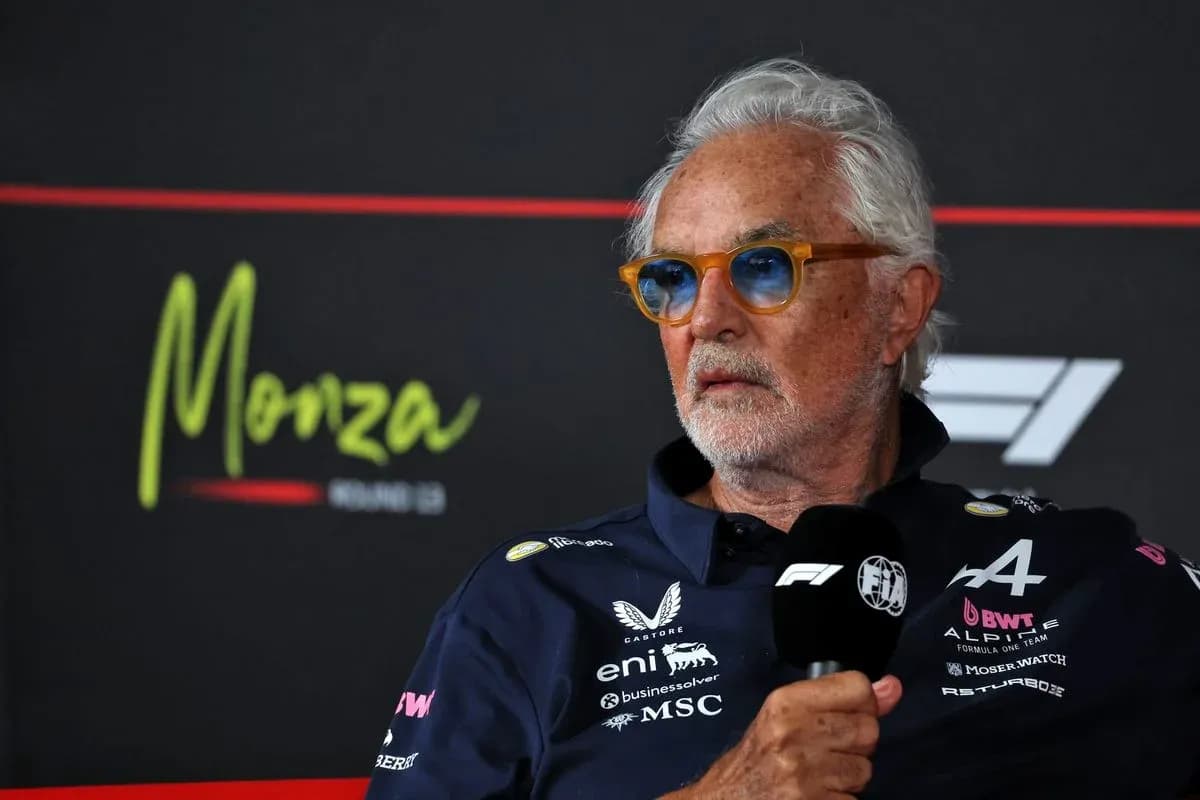
Flavio Briatore walked into the press conference room on Friday with a folded sheet of paper and a storm already brewing.
Hours earlier, the FIA’s International Court of Appeal had published its verdict: McLaren and Red Bull had succeeded in their bid to overturn Pierre Gasly’s Monaco Grand Prix podium. Alpine’s celebrations from Monte Carlo were officially erased. The legal fight that had dragged on for three months ended with a blunt conclusion – and Briatore was in no mood to accept it quietly.
He didn’t go after the logic of the ruling. He went after one of the judges.
Briatore lights the fuse
“Filippo Marchino is a judge, he was very nasty during the hearing, was acting as a prosecutor,” Briatore said, reading from his notes, each line delivered like a charge sheet.
“And after, we found out what is the reason why so nasty, this guy. He is very linked with McLaren.”
The Alpine executive advisor called the situation “very unfair”, then claimed he had “a nice picture of this guy at a speech for McLaren in 2018 in MSO, Beverly Hills,” though he did not show the image.
Briatore went further.
“He has a foundation, it's called One Drop Foundation, and McLaren gave two, three McLaren cars. This was quite unfair.”
Those cars were linked to a 2019 charity auction for the One Drop Foundation, on whose board Marchino sits. One Drop was founded by Guy Laliberté, co-founder of Cirque du Soleil and a long-time associate of McLaren through his friendship with former team boss Ron Dennis. In that light, McLaren providing items for a charity auction fits a familiar pattern of paddock relationships and philanthropy.
Briatore, though, framed it as something far more troubling: a link that, in Alpine’s eyes, should never have sat so close to a verdict that stripped its driver of a Monaco podium.
McLaren hits back
The comments detonated in the room. FIA officials looked stunned. McLaren’s team principal Andrea Stella looked furious.
“I find that this conference going in this direction is quite insulting for McLaren, for the reputation of a team that deserves a lot of respect,” Stella said, his voice tight with anger.
“If anybody makes these kind of allegations – which seem quite serious – they are going to have to take the responsibility for what they are saying in a public forum.
“The hearing, the whole International Court of Appeal, was conducted to the highest standards and we should not question this phase like it’s been done.”
For McLaren, Briatore’s insinuation cut directly at the team’s integrity and at the legitimacy of a process that had just delivered them a crucial legal win. For Alpine, it was framed as a matter of fairness and transparency.
Briatore made it clear he did not consider the case closed.
“We’ve been thinking about it,” he said when asked if Alpine would push further. “Just pass the weekend and after that we think about it. For the moment, I don’t know.”
The suggestion was clear: Alpine is weighing its next move.
What room is left to fight?
On paper, there isn’t much.
The FIA’s International Court of Appeal is the final judicial authority in motorsport under the federation’s umbrella. Its decisions cannot be appealed in the usual sense. Once the ICA speaks, the case is supposed to be over.
There is, however, a narrow door still open: a right of review. Similar to the mechanism available for stewards’ decisions, it allows a case to be revisited if “important new evidence is discovered which was unknown at the outset of the case before the ICA”.
Briatore claimed Alpine only learned of Marchino’s alleged links to McLaren after the hearing.
“We found out, after the meeting, logically, not before,” he said. “We found out this guy was linked with the McLaren team.”
Whether that qualifies as “important new evidence” is another matter entirely. The FIA stressed on Friday that the composition of the ICA panel is not thrown together casually. It is vetted, structured, and communicated in advance.
The International Court of Appeal maintains a roster of 36 leading legal experts. For each case, at least eight are shortlisted for a pool from which the final panel is drawn. That shortlist is sent to the parties involved well before the hearing. Teams then have the chance to raise “serious and objective reasons” why any of those judges should be recused for conflicts of interest or other valid grounds.
Alpine did not object at any point in that process.
With no objections lodged, ICA president Laurent Anselmi, from Monaco, selected four judges for the hearing.
There is another layer of significance here. Under Formula 1’s regulations, any ICA panel dealing with a world championship matter must include at least one judge elected to the pool at the FIA General Assembly on the proposal of at least five teams or three manufacturers.
In 2023, Marchino – along with Luigi Fumagalli, who also sat on the Monaco appeal panel – was nominated at the FIA General Assembly after being put forward by teams. Any such nominees undergo due diligence by the FIA compliance officer, are reviewed by an ad hoc panel, and then assessed by an eligibility committee.
Once a judge is called for a specific case, they must confirm to the FIA secretary general that no conflict of interest exists. Only after that confirmation is the final panel fixed, its composition kept secret from everyone involved until the day of the hearing.
That is the process Alpine chose not to challenge at the time. Now, Briatore is trying to prise it open after the fact.
A verdict delivered, a paddock on edge
Gasly’s lost Monaco podium had already become a symbol of the fine legal margins in modern Formula 1. Friday’s ruling restored McLaren and Red Bull’s version of events and rewrote the Monte Carlo top three. The sporting consequence is clear.
The political fallout is anything but.
Alpine must now decide whether Briatore’s accusations will turn into a formal attempt to trigger a right of review, or whether this remains a public broadside with no legal follow-up. The FIA, for its part, stands behind a structure it insists is tightly controlled and rigorously vetted. McLaren has made it plain it will not let its name be dragged through the mud without response.
The Monaco GP podium has already taken three months to settle in courtrooms and hearing rooms. The verdict is written. The trophies have homes.
Whether this fight is finally over, or about to enter an even more contentious phase, now rests with a team still seething over a lost day in Monte Carlo.