.svg&w=384&q=75 "logo")
Arthur Gea's Heartbreaking US Open Journey
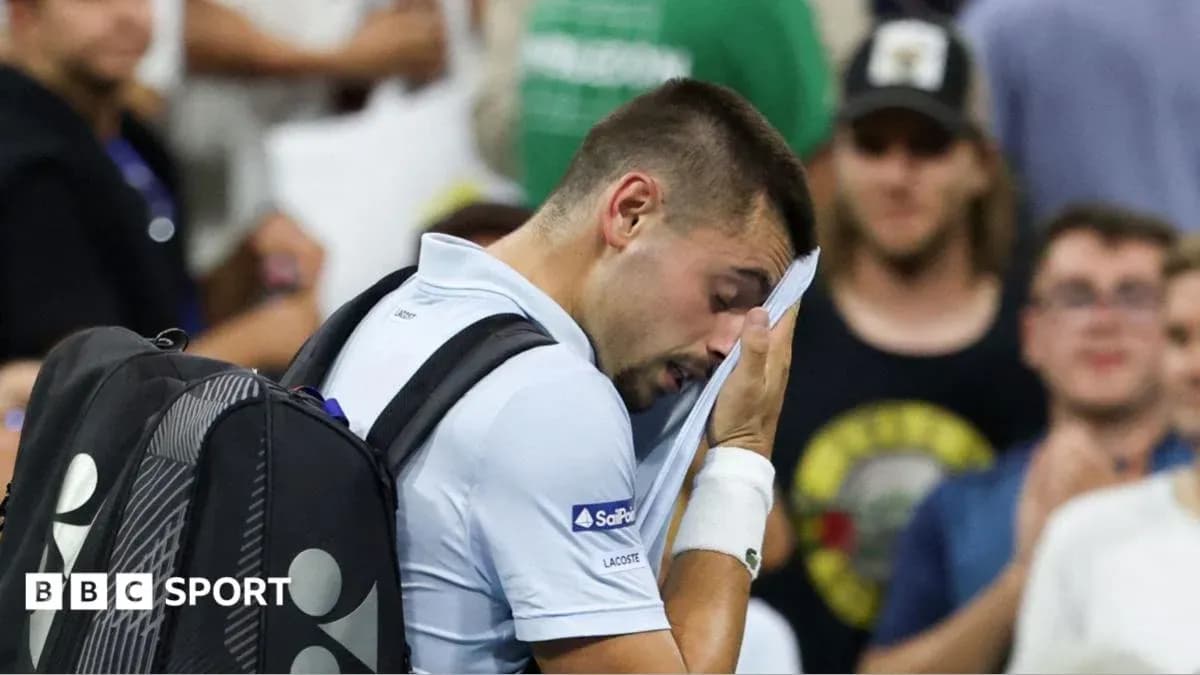
Arthur Gea stood one point from history. Three hours later, he was out of the US Open.
The 21-year-old Frenchman, a lucky loser who had ridden a late reprieve into the main draw, came within a single point of becoming the first lucky loser ever to reach a Grand Slam quarter-final. Instead, he walked off Louis Armstrong Stadium with a five-set defeat, a shattered opportunity and a harsh lesson in how brutal this sport can be.
From match point to heartbreak
Facing Dutchman Botic van de Zandschulp, Gea led by two sets and held match point in the third-set tie-break. The moment was there. The story was writing itself.
He couldn’t take it.
Van de Zandschulp wriggled free in that breaker, then watched Gea falter again when serving for the match in the fourth set. The pressure finally told, and once the door opened, the Dutchman stormed through it.
After five hours and 13 minutes – the fourth-longest match ever recorded at Flushing Meadows – Van de Zandschulp completed a 3-6 6-7 (0-7) 7-6 (9-7) 7-6 (7-3) 6-4 comeback that he later described as a “crazy” turnaround and one he admitted he had “no clue” how he pulled off.
Gea, ranked 87 in the world, had already stretched his week far beyond expectation. He was not even in the main draw when the entry list closed, forced to navigate qualifying as the top seed. There, he lost in the final round to American Nishesh Basavareddy and thought his tournament was over, his cheque capped at $66,000.
Then Casper Ruud withdrew on the eve of the event. Gea’s name went back up on the board.
He seized the second chance with real authority: wins over Juan Manuel Cerundolo, Zachary Svajda and Michael Zheng carried him into the last 16 and into the New York spotlight. For three sets and most of a fourth against Van de Zandschulp, he looked ready to push the door off its hinges.
But Grand Slams are unforgiving. One missed match point, one failed service game, and a place in history slipped away. Instead of a quarter-final, Gea becomes the 13th lucky loser to fall in the fourth round of a major. The consolation? A $480,000 payday that dwarfs what he expected when he packed his bags for qualifying.
Van de Zandschulp sets up Zverev rematch
Van de Zandschulp, ranked 70, now finds himself back in familiar territory in New York. This is his second US Open quarter-final, and his reward is as tough as they come: a showdown with top seed Alexander Zverev.
If the Dutchman’s path was chaotic, Zverev’s evening was the opposite – controlled, clinical and, for once, early.
The German, 29, finally avoided another New York graveyard shift, dispatching Italian 21st seed Luciano Darderi 6-2 6-2 7-6 (7-3) in straight sets. After three consecutive matches that ended at 1:55am, 2:15am and 1:09am, Zverev walked off court before midnight and joked he didn’t quite know what to do with the extra hours. He even quipped about heading back to the practice courts or a bar.
He made one thing clear: he wants the lights again on Wednesday.
Zverev, the reigning French Open champion, said he will request another night session for his quarter-final against Van de Zandschulp, laughing that he has “rented this court out from 11pm until 2am for two weeks” and hopes the schedulers keep him under the lights.
Blockx limps, then fights, into history
Earlier in the day, another young name carved out a slice of Belgian tennis history.
Alexander Blockx, the 28th seed, looked at times as if he might not finish his fourth-round match against Francisco Cerundolo. Rib pain hampered him from the start, especially on serve, and he admitted he came close to retiring. The pain worsened as the match wore on. The temptation to stop grew with it.
He refused.
Blockx hung in and turned a fragile situation into a landmark victory, grinding past the Argentine 6-3 4-6 7-5 7-5 to reach his first Grand Slam quarter-final. In doing so, the 21-year-old became the first Belgian man ever to reach the last eight at the US Open.
He later said that if he had lost the third set, the chances of him retiring would have been “really high”. Instead, he pinched it, then backed it up in the fourth, riding sheer stubbornness and just enough first serves to the finish line. “I’m glad that I kept on playing,” he said, and with good reason.
Provided his body allows, Blockx now faces Russian world number 50 Karen Khachanov in the quarter-finals on Wednesday.
Khachanov, 30, had his own five-set test, recovering from two sets to one down to end American Learner Tien’s run. The 14th seed had been part of a broader home surge, chasing a piece of history for US men’s tennis, but Khachanov shut that door with a 7-5 4-6 6-7 (6-8) 6-1 6-4 win that halted the bid to place four American men in the US Open quarter-finals for the first time since 1995.
On a day of comebacks, collapses and bodies pushed to their limit, New York’s hard courts demanded everything. Some players walked away with history, others with regret, and a few with both. The question now is who still has enough left – in the legs and in the head – to survive the next five-set storm.