.svg&w=384&q=75 "logo")
Argentina Faces Heavy Sanctions After World Cup Final Chaos
Argentina’s bid for back‑to‑back world titles ended with a 1-0 defeat to Spain in the 2026 World Cup final. What followed has left an even deeper scar than the scoreline.
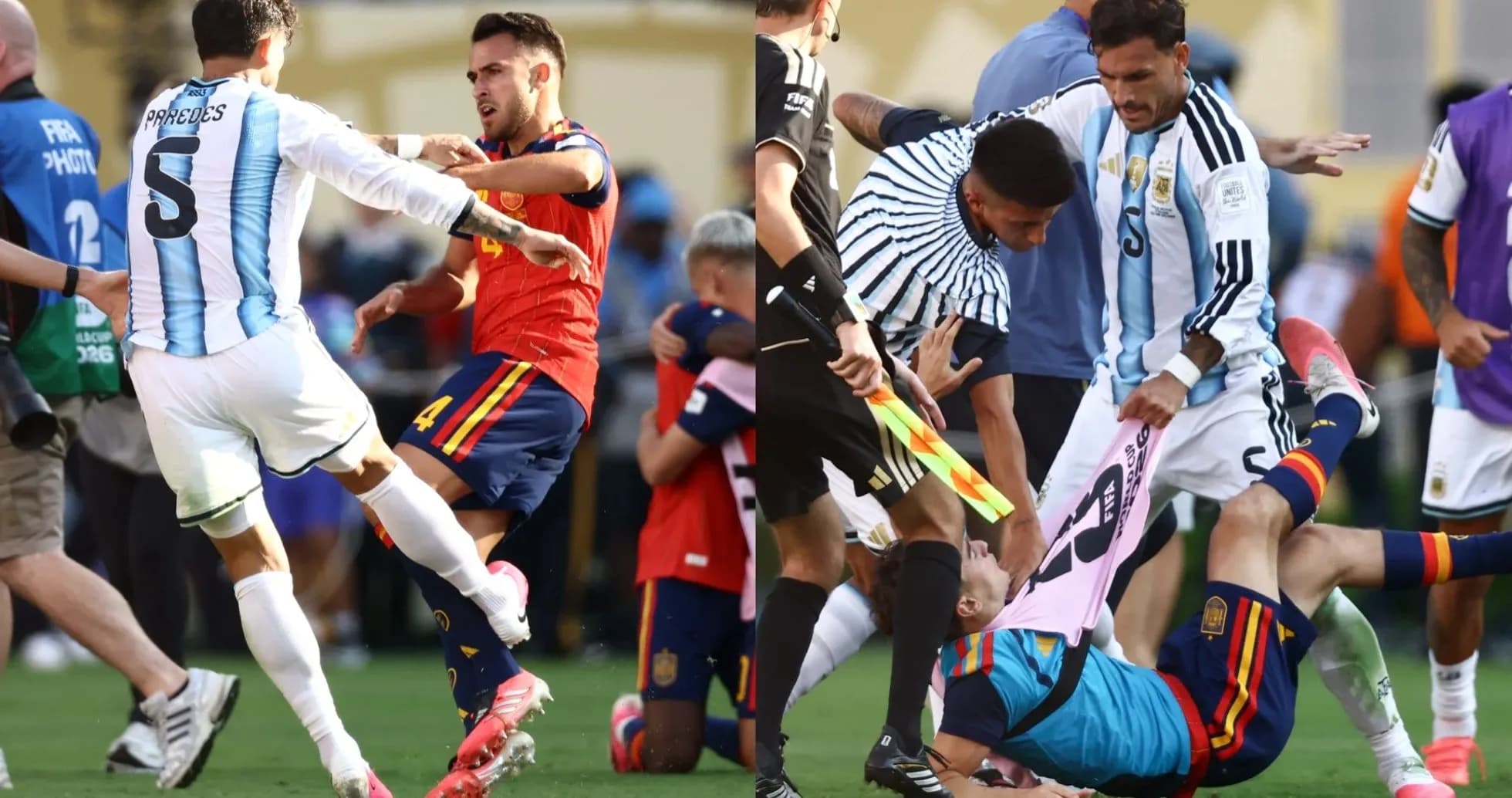
The showpiece in North America will be remembered less for Spain’s triumph and more for the chaos that erupted after the final whistle, a brawl that has now drawn some of the heaviest sanctions FIFA has handed down to a reigning world champion.
Paredes hit with brutal 10-game ban
Leandro Paredes has paid the steepest price.
The 32-year-old midfielder received a 10-match suspension and a £65,000 fine after FIFA reviewed footage of him grabbing Eric Garcia by the throat, striking Gavi in the face, and then shoving the Spanish teenager to the ground. In a final already loaded with tension, his actions became the flashpoint that defined Argentina’s night.
Nahuel Molina did not escape lightly either. The right-back was banned for seven matches for striking Spain captain Rodri in the torso, an incident that helped ignite the mass confrontation between both sets of players and staff.
Thiago Almada and Gavi were also punished, though far less severely. Each received a one-match suspension for their roles in the melee, collateral in a wider disciplinary crackdown.
Assistant coach Roberto Ayala was among several Argentine staff members sanctioned as FIFA moved to stamp its authority on a final that spiralled out of control.
AFA plays the long game
Faced with a stack of bans and heavy fines, the Argentine Football Association (AFA) moved quickly. Survival mode, but with a strategy.
In a formal request to FIFA, the AFA asked that the suspensions picked up in the World Cup final – and the sanctions against the association itself – be served in Class A friendlies and/or official matches, whichever comes first.
FIFA’s Disciplinary Committee agreed. The approval, confirmed in an AFA statement, transforms the outlook for Lionel Scaloni’s squad. Instead of losing key players for a chunk of the next major tournament, Argentina can burn through those bans in friendlies.
The AFA isn’t finished, though. It is still waiting for the written reasoning behind FIFA’s decisions and has already flagged its intention to appeal to FIFA’s Appeals Committee, with the Court of Arbitration for Sport (CAS) on standby as a possible final stop.
Political flashpoint after England semi-final
The final wasn’t Argentina’s only disciplinary headache at the tournament.
After their semi-final win over England, several players – including Lionel Messi, Cristian Romero, Giovani Lo Celso, and Lisandro Martinez – celebrated with a banner declaring that the Falkland Islands belong to Argentina. The image ricocheted around the world and triggered calls for individual bans over the political message.
Those bans never came. FIFA stopped short of targeting the players directly and instead hit the AFA with a £235,000 fine, with £73,000 of that amount suspended. The governing body also ordered a partial stadium closure for Argentina’s next two home matches, limiting attendances to 50 per cent. One of those closures is itself suspended, a warning hanging over future behaviour.
The message from Zurich was clear: the line between national passion and political provocation had been crossed.
Friendlies as a fast track
Now comes the pragmatic phase.
By allowing the suspensions to be served in non-competitive fixtures, FIFA has given Argentina a path to clear the decks before the next major test. The AFA is expected to pack the calendar with Class A international friendlies, using every available window to chip away at Paredes’ 10 games and Molina’s seven.
There is time to do it. Plenty of it.
As co-hosts of the 2030 centenary World Cup, Argentina are already guaranteed their place at the tournament. That removes the pressure of qualifiers and means their next meaningful competitive football will not arrive until the 2028 Copa America.
Between now and then, the plan is obvious: schedule high-profile exhibition matches, restore rhythm, and reintegrate the suspended players long before another trophy is on the line.
The World Cup final in 2026 ended in defeat, disorder, and a raft of punishments. The response from Buenos Aires will decide whether that night becomes a turning point in this generation’s legacy or a stain they never quite manage to erase.