.svg&w=384&q=75 "logo")
Katie Taylor's Perfect Exit: A Sporting Legacy
Katie Taylor walked away on her own terms, into that vast, unknowable space that has swallowed so many great athletes before her.
Sport is littered with cautionary tales. Premier League stars, NFL heroes, champions from every code who find that the roar stops, the lights go out, and the bills and the silence close in. They call retirement a first death for a reason.
Boxing has always understood that better than most. Eddie Arcaro once said that when a jockey retires he becomes “just another little man”. Ray “Boom Boom” Mancini, a former WBA lightweight champion, admitted that after he quit he ate less, weighed less, trained less, cared less. Both men built decent second lives. Both still struggled.
Taylor now stands on that same cliff edge. The difference is that she leaves with something approaching the perfect exit.
A farewell that rewrote the script
As Irish sporting retirements go, this one sits alone at the summit. Brian O’Driscoll’s long goodbye in 2014, capped with a Six Nations title, has long been held as the gold standard. Croke Park on Saturday night pushed it into a distant second.
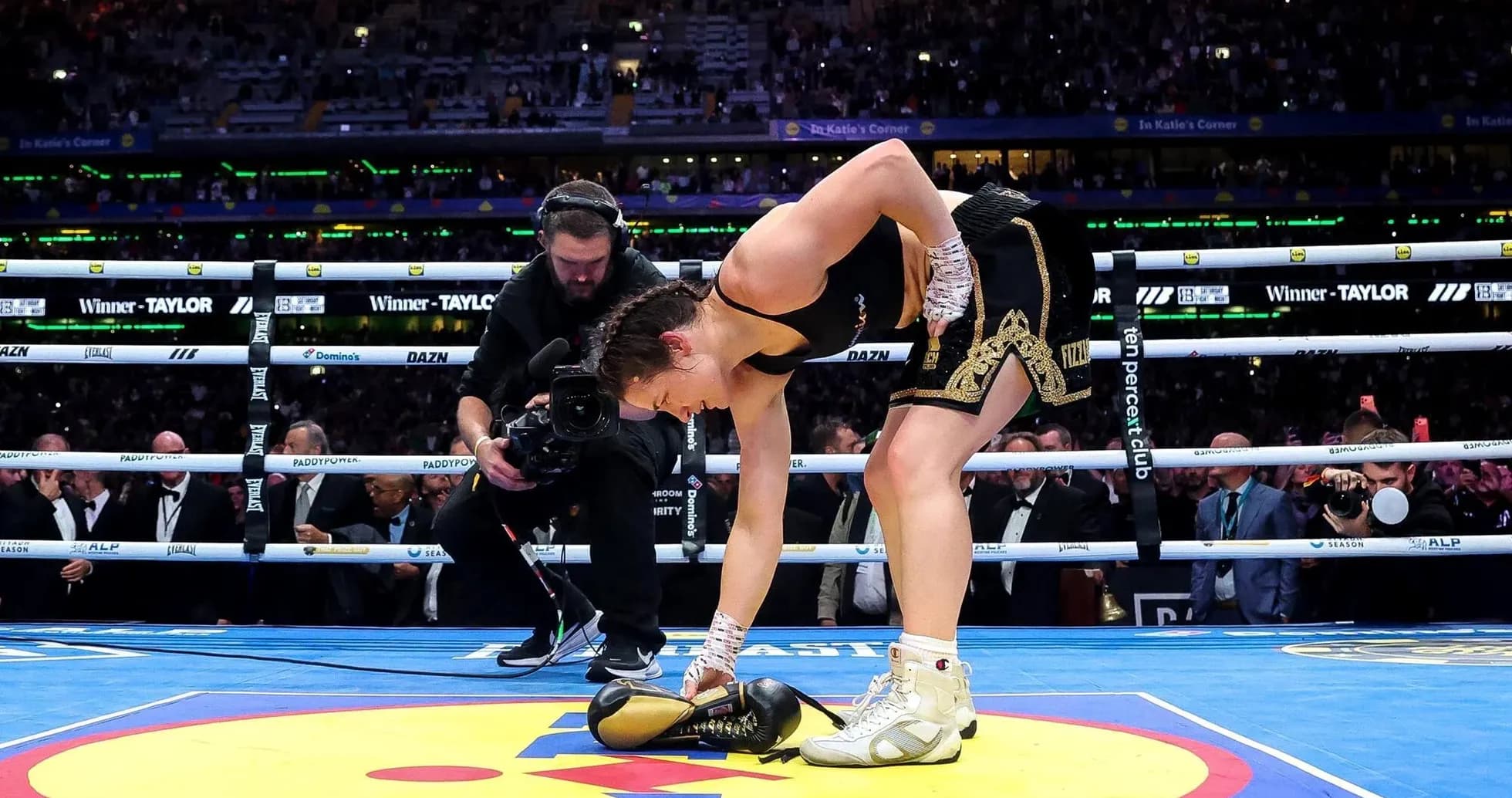
Taylor’s final act in the ring – a composed, classy win over Flora Pili – delivered a performance that matched the occasion. The purse, expected to be around €3m, will land on top of the fortune she has already amassed, including more than €7m from the last of her three fights with Amanda Serrano. She does not leave because she is broke. She does not leave because she needs the money.
Alan Minter once joked that there were only two reasons boxers came back: they were either broke, or they needed the money. Taylor, for now, is safely outside that grim logic. That alone separates her from the majority of her peers.
Everything about the night felt deliberate, crafted, almost cinematic. The horseshoe stands, the noise, the emotion that spilled long after the final bell. If you were designing an Irish sporting farewell in a lab, you would have struggled to improve it.
The next act, written in pencil
So what does she do now?
If Brian Peters gets his wish, the next time most people see Taylor will be not under lights, but under strip bulbs in parish halls and community centres. Inisbofin, and a necklace of similarly unlikely venues across the country, are pencilled in for a nationwide stage play, “Her Story”, where she will sit down with Steve Bunce and revisit the journey.
“It's going to be quite magical,” Peters said.
The idea of Taylor willingly travelling the length and breadth of Ireland to talk about herself feels at odds with the version of her the country thinks it knows. This is the fighter who built a career on silence, who hid from the spotlight even as it chased her. Yet second acts rarely follow the script we expect.
Who saw Roy Keane becoming a media star and advertisers’ favourite? Who predicted Bill Belichick’s public image would unravel so quickly once he ceased to be the New England Patriots head coach? Sport has a way of flipping personas once the games stop.
Taylor gave a hint of that shift in the final week. She spoke more than she ever has. Eddie Hearn even joked about the length of her post-fight speech in the ring after she beat Pili. The voice has always been there. The question now is whether she chooses to use it.
“I determined very, very early on in my career not to talk but to show my boxing skills and just to let my excellence do the talking and let my talent do the talking,” she said on Sunday morning. “And I've kept to that throughout my whole career.”
Those skills, and that discipline, do not have to be lost to the sport.
A generation already in her shadow
It feels inevitable that Taylor will stay involved in boxing in some shape or form. That simple assumption, though, opens more doors than it closes. Coaching is the obvious path. Mentoring is another. Advisory roles, ambassadorial positions, high-performance structures – all would welcome her without hesitation.
Her influence on one generation of Irish fighters, male and female, is already profound. They have queued up to say it. Many of them would not have laced a glove without her example. The image of her sparring with 10-year-old Clodagh Keating last week captured that better than any speech. One icon, one child, and the line between them.
Taylor was asked whether a formal role in Irish boxing might be on the horizon. She smiled and pointed to the reality of life. Her husband is in Connecticut. Their home is there. There are six children whose futures matter more than any programme or title. Her attempts to convince him to relocate, she joked, had not “gone down very well”.
If boxing remains a constant, it will share space with two pillars that have always anchored her: family and faith.
Faith in the spotlight
Both were on show at Croke Park. As she walked to the ring to “All Hail King Jesus”, her beliefs were no longer a quiet undercurrent. They were front and centre, set to music, framed in lights. Afterward, she spoke openly about how clinging to her faith and what she believes is the word of God carried her through the darkest moments – the heartbreak of Rio 2016, the personal difficulties that followed, the shadow of loss that has hung over parts of her story.
“Look what God's done. He's done the impossible in my lifetime and he's came through time and time again. And that's what I was saying in the ring afterwards and giving him all the glory and the honour for all that I've achieved.”
That kind of open declaration sits more comfortably in the American sporting landscape she now inhabits than in an Ireland still working out its relationship with religion. Yet it has never really jarred with the public at home. The affection for her has been too deep, too broad, too instinctive for that.
The adoration that poured off the Croke Park stands and into the September night told its own story. People did not come to argue with her beliefs. They came to say thank you.
A status beyond sport
Hers is a standing that stretches beyond medals and belts. In Irish sport, there has been nothing quite like it. In Irish public life, there are few comparisons either. Part of its power lies in the fact that nobody has fully explained it – not commentators, not team-mates, not fans.
Not even Taylor herself.
“I don't know, to be quite honest,” she admitted. “I think people, the whole country, has seen me and my good times and they have also seen me during my devastations as well. I think people really resonate with your vulnerabilities as much as your successes.
“They see me cope with the heartbreak of Rio. They see me cope with the heartbreak of the shadow of loss. They see me in the, just, personal difficulties as well. So yeah, I think my story is the story of everybody in the whole country.”
That might be it. The knockdowns, the comebacks, the quiet days when nothing made sense – all played out in public, all carried with a kind of stubborn dignity that people recognised in their own lives.
The belts will be boxed up now. The training camps will fade into memory. The next chapter, whatever form it takes – parish halls, coaching rings, or something none of us has yet imagined – will be written at a different pace.
Her story? It isn’t finished. It has simply moved to another ring.