.svg&w=384&q=75 "logo")
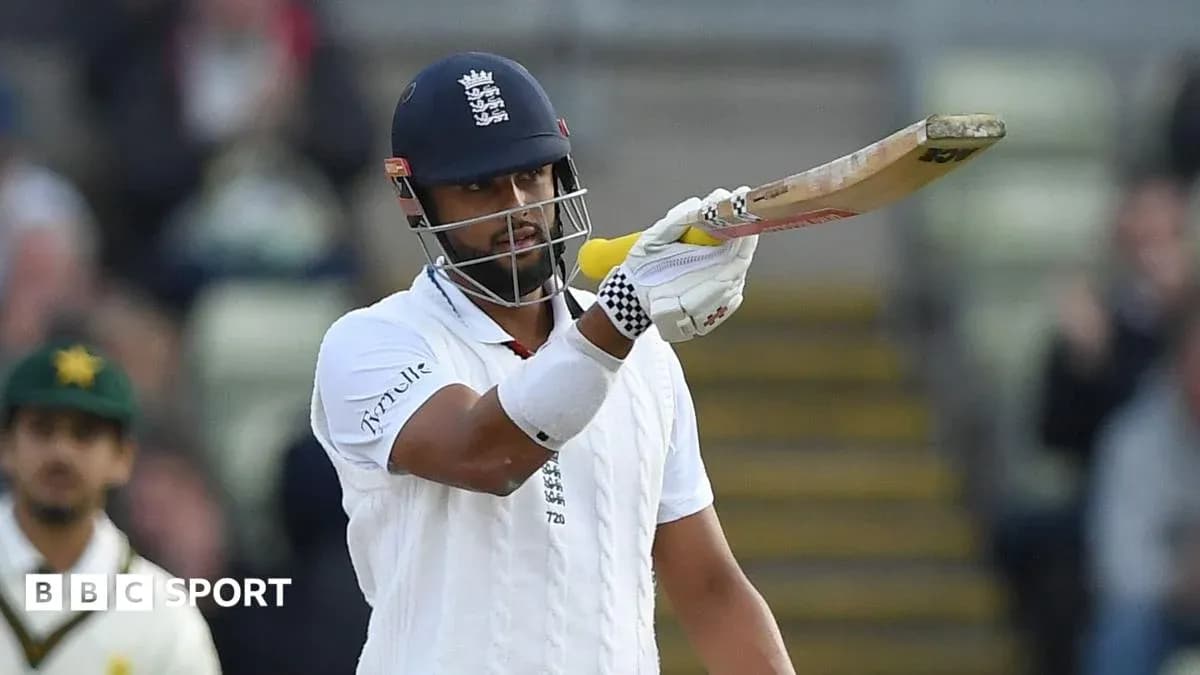
Emilio Gay's Edgbaston Performance: A Crucial Statement for England
Emilio Gay’s Edgbaston statement has come at exactly the right time, and Sir Alastair Cook believes England must listen.
On a day when Pakistan’s quicks repeatedly beat the bat and the ball once again lorded it over the bat in this peculiar English summer, Gay dug in, then pushed back. His 60 from 114 balls was not a headline-grabbing hundred. It was something more valuable to a side still searching for stability at the top: proof of method, proof of temperament.
Cook’s seal of approval
Cook, who knows more than most about the art of opening in Test cricket, has seen enough.
“I think Emilio Gay’s played really nicely. I would say he’s confident and intense,” he told Test Match Special, sounding every inch the selector-in-waiting rather than the retired great. “He is definitely a run-getter when he gets in. He seems to have that real stubborn and strong will to make it count if he can.
“He has done enough for me to take him to South Africa to continue the progress of a player where the pitches will be slightly easier to bat on and he should open the batting.”
When a man with almost 12,000 Test runs as an opener talks about stubbornness and strong will, it carries weight. Cook has been struck not by the flourish of Gay’s strokeplay, but by the discipline that underpins it.
Numbers that tell a different story
On the surface, Gay’s record this summer is modest: 261 runs at 26.1. In another era, in another year, that might get lost in the shuffle.
This season, it demands context. Ben Duckett is the only England player to reach three figures in six home Tests. Seamers have feasted, batters have survived rather than thrived. In that landscape, Gay’s willingness to grind, to leave, to defend, has stood out.
CricViz data underlines it. Since his debut against New Zealand in June, Gay has left or defended 61% of the pace deliveries he has faced. Among recent England openers in a home summer, only Dom Sibley in 2020, with 68%, has gone to his shell more often.
At Edgbaston, the numbers were even starker. During his 60, Gay left or defended 65 balls, frustrating Pakistan’s new-ball pair and blunting the early threat. Cook, watching closely, particularly admired how late he brought the bat down.
Method before glamour
There was nothing frenetic about the way Gay built his innings. The first 12 runs of his half-century took 43 balls. He looked content to absorb, to let the day breathe, to make Pakistan work. Once in, he shifted gears, the next 38 runs coming from 52 deliveries.
He hit nine fours, and 68% of his Test runs so far have come in boundaries – the joint-highest proportion of any England batter with at least 250 runs in the format. It’s a neat paradox: a player praised for his patience who, when he does play, scores quickly.
Cook sees a rounded game emerging.
“If you take Gay’s innings, and what I’ve seen of him, he’s not hunting that drive too often. He waits for it to come into there,” he said. “He scores off the back foot through the off side as well. He scored through the leg side and timed them through mid-wicket so he does have an all-round game. He’s not limited to the off side.”
This is the balance England have craved: an opener who can leave with conviction, then cash in with authority.
A chance missed, a point made
Not everyone in the commentary box was entirely satisfied. Michael Vaughan admired the innings but could see the regret etched into Gay’s walk back.
“Emilio Gay found his balance early. He had it hard at the start and then he found his flow,” Vaughan said. “He’ll be really disappointed to get out for 60. He’ll be desperate to get his first Test match century and I thought it was on today.
“That extra little bit of pace from Razaullah and a little lack of concentration at the end of the day has cost him.”
Gay dragged on against Razaullah Khan just as three figures began to look inevitable. The dismissal hurt him; that much was obvious. Yet the damage to Pakistan had already been done. The new ball had been tamed, the shine knocked off, the platform laid.
Built in the nets, proven in the middle
Inside the England camp, none of this has come as a surprise. Seamer Josh Tongue has seen the foundations up close.
“The one thing I’ve seen in Emilio is he trains really hard in the nets. He’ll bat for ages, putting a lot of hard work in, and it’s shown on the pitch,” Tongue said.
“Even last week at Lord’s, he had two quite horrible dismissals, but I felt today he batted unbelievable on a tricky pitch.
“He was obviously really disappointed with how he got out. It’s not a nice feeling, chopping on, but he’s put the team in a really good position for tomorrow.”
Those “horrible dismissals” at Lord’s could have dented a younger player’s confidence. Gay used them as fuel. The response at Edgbaston – more leaves, later defence, tighter judgement – suggested a mind already tuned to Test-match problem solving.
South Africa calling?
England’s winter tour to South Africa will ask different questions. Harder, truer pitches. More pace. Less lateral movement. Openers can’t simply survive there; they have to score.
Cook believes that is exactly where Gay’s game can grow. The numbers show a man who knows how to say no. The eye test shows a player who, once set, knows how to say yes with force.
In a summer where batting has felt like an act of resistance, Emilio Gay has turned 60 into an argument. Not a perfect innings. Not yet a defining one. But for an England side still sketching out its future at the top of the order, it might just be the start of something they have been missing for years.