.svg&w=384&q=75 "logo")
Elena Rybakina Becomes First Kazakhstani No. 1 in Women's Tennis
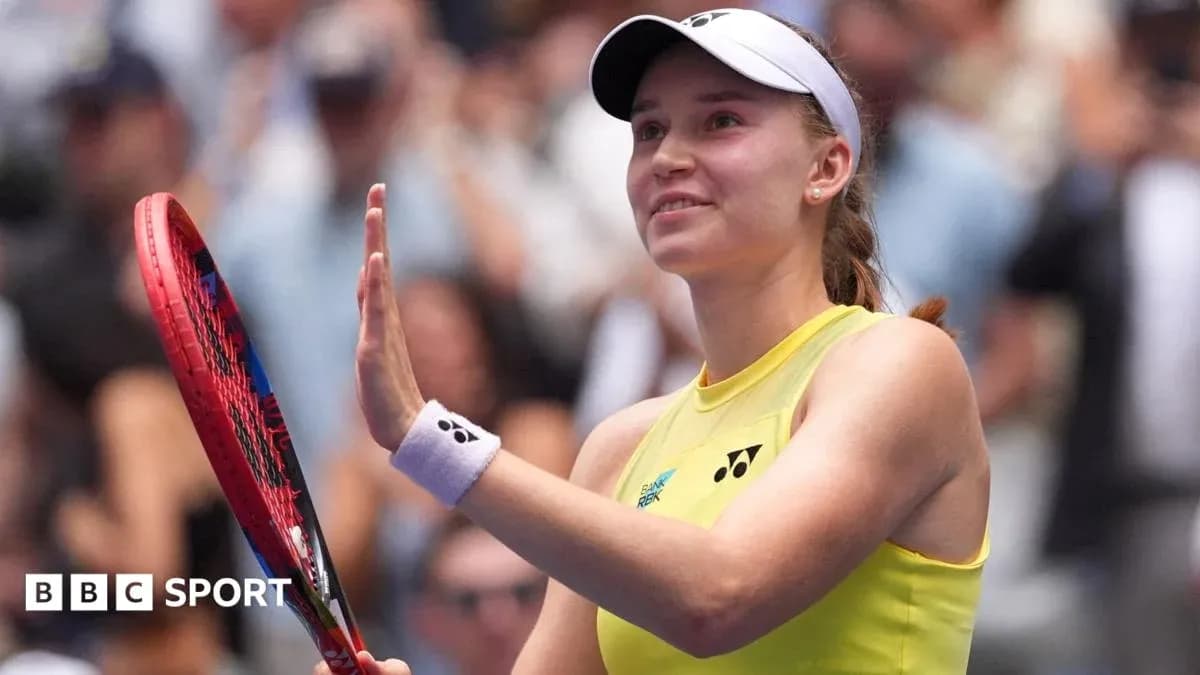
For 99 weeks, women’s tennis had one constant: Aryna Sabalenka on top of the world. On Monday, that changes. The new name at No 1 will be Elena Rybakina.
The Kazakh sealed it under the New York lights, grinding past Zheng Qinwen 3-6 6-1 6-4 in the US Open quarter-finals. It was the first time she had dropped a set all tournament. It did not rattle her. When the match tightened in the decider and a break point flashed in front of Zheng, Rybakina shut the door, then shut down the contest.
With that, history. She becomes the first Kazakhstani player, man or woman, ever to lead the singles rankings.
A chase that started last year
This ascent did not begin in New York. It started in the grind of the late 2025 calendar.
Back then, Sabalenka still held the edge in their rivalry. She beat Rybakina in the Wuhan Open quarter-finals in October, a reminder of who owned the top line of the rankings. Rybakina’s response was sharp and ruthless: the Ningbo Open title a week later, then a statement win at the season-ending WTA Finals, where she took revenge on Sabalenka to lift the trophy.
That run lit the fuse.
Rybakina carried that surge into 2026. In Melbourne, she outlasted Sabalenka in a major final that felt like a power struggle for the sport’s future. Three tight sets, heavy serving from both sides, and Rybakina walking away with the Australian Open – her second Slam, almost four years after Wimbledon first announced her to the wider world.
Sabalenka hit back in the spring hard-court swing, edging their battles in the Indian Wells final and the Miami Open semi-final. Rybakina answered on clay, taking the Stuttgart title while Sabalenka’s form wobbled.
The summer looked like it might stall her charge. Early exits at Roland Garros and Wimbledon, then a run to the Toronto final that ended in straight sets against Iga Swiatek. In Cincinnati, the body finally protested: a left ankle problem forced her to retire from her quarter-final against Swiatek, her movement compromised, her serve blunted.
That could have been the derailment. Instead, it became part of the story.
From shaky prep to the summit
Before the US Open, Rybakina admitted her preparation “wasn't great”. The ankle had bothered her for a long period, training time was limited, and she came into New York without the ideal runway. She insisted she had the issue under control. The evidence is now on the scoreboard and about to be on the rankings list.
This fortnight, she arrived as one of three women with a realistic shot at dislodging Sabalenka. Jessica Pegula and Coco Gauff were the others. The equation for all three was brutal: win the title and hope Rybakina failed to reach the semi-finals. Rybakina tore that script up by marching into the last four herself.
Sabalenka’s 99-week stay at No 1, stretching back to 21 October 2024, will stand as the sixth-longest reign in WTA history. It took a sustained, season-spanning push to end it, not a one-off hot streak. Rybakina has been coming for this for months.
And yet, to hear her talk, the ranking is not the prize she cares about most.
“It’s just a number right now. My goal is to win the tournaments which I play,” the 27-year-old said. An “amazing achievement”, yes, but she knows how quickly rankings can flip in a sport that moves week to week.
The next task is already in front of her: a US Open semi-final on Thursday against either Coco Gauff or Mirra Andreeva. On the other side of the draw, Sabalenka faces Pegula. The possibility hangs there, tantalisingly familiar – a rematch of this year’s Australian Open final, this time in New York, this time with the official No 1 and the dethroned queen trading places in the rankings but not in ambition.
A partnership tested and renewed
Behind Rybakina’s rise sits a partnership that has been as scrutinised as it has been successful.
She has worked with coach Stefano Vukov for almost seven years, first teaming up in 2019. Their split in 2025 looked like a clean break until the story grew heavier: later that year, Vukov was banned from the WTA Tour for breaching its code of conduct after an independent investigation into his behaviour towards Rybakina.
He denied wrongdoing. Rybakina said she was never mistreated by him. Crucially, she wanted him back.
At the start of 2025 she pushed for his return to her team. Vukov appealed the suspension and won. By August, they were reunited, and Rybakina promptly reached the US Open fourth round for the first time in her career. From there, the late-season surge that began in Ningbo and culminated at the WTA Finals pushed her into this year’s title fights and, ultimately, to the top of the rankings.
The arc is striking: from reunion to resurgence, from questions over a coaching relationship to the pinnacle of the sport.
Now Rybakina stands one match from another Slam final and days away from seeing her name printed at No 1 on the WTA list. The ranking is “just a number,” as she says.
The way she earned it suggests it might be a number that stays for a while.