.svg&w=384&q=75 "logo")
Babar Azam's Struggles Amid Pakistan's Cricket Crisis
The day was barely awake when Babar Azam walked out at Edgbaston. Forty-five minutes into the Test and the shape of it already felt grimly familiar. Pakistan three down, the floodlights cutting through a late-summer gloom, a bruise of black cloud dragging itself across the sky. A few drops of rain in the air. Ollie Robinson nagging away with the keeper up and five slips waiting like vultures. Jofra Archer loosening from the other end, four overs in and getting quicker.
It was a brutal time to bat.
Lately, it always is for Babar.
Not long ago he was one of the game’s great certainties. In 2022 he stacked up the kind of scores that define a career: 196 against Australia in Karachi, 119 in Galle, 136 in Rawalpindi, 161 back in Karachi against New Zealand. He ended that year averaging 49 in Tests, ranked third in the world, crowned ICC Men’s Cricketer of the Year. He looked nailed on for the pantheon.
Since then, the numbers have turned on him. No Test hundred. Twenty matches, a top score of 88, an average of 29. The decline has been slow enough to explain away in patches, stark enough now to feel inescapable.
Close your eyes and you can still picture the old version: Babar soaking up pressure, steering chaos into something like control, stitching together a broken innings while the storm rages around him.
Then you open them.
He set himself for Robinson’s first ball and immediately betrayed the uncertainty that has crept into his game. Half-committed, bat coming through then yanked inside the line at the last instant. The next delivery zipped past his outside edge. The third he clipped through square leg for his first runs, a neat little nudge that once would have settled him.
It didn’t.
Archer tested him with a short ball in the next over. Babar slashed, missed. Then came Gus Atkinson, beating him twice before a thick edge squirted away for four. There was no rhythm, no command, only survival. Barely that.
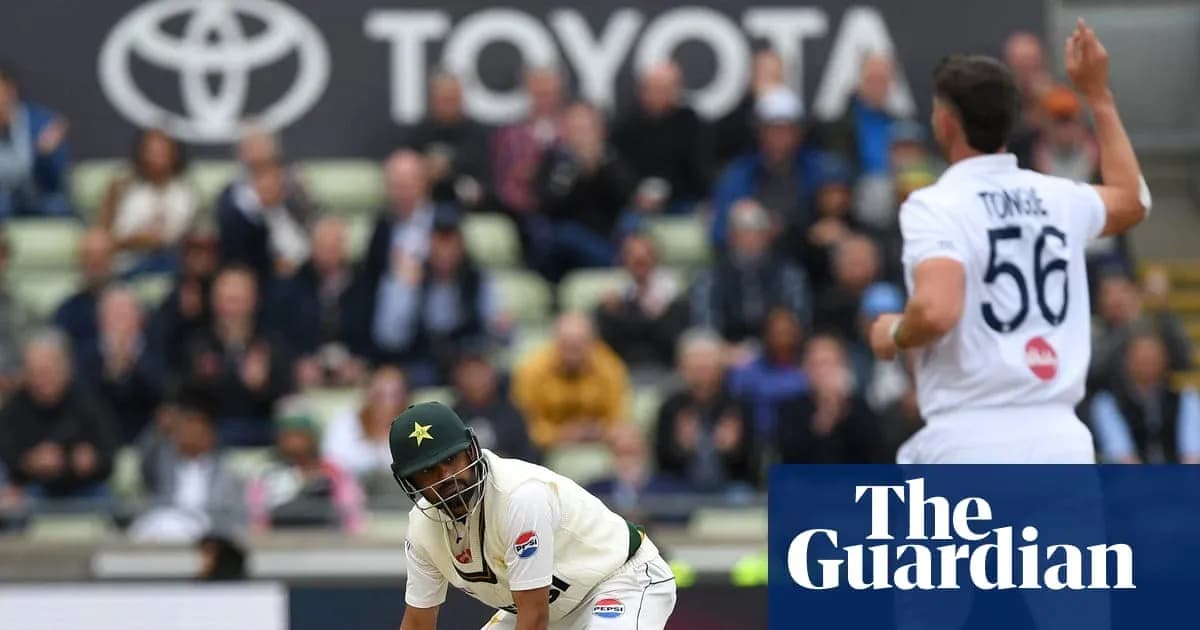
In the fourth over of his innings, Josh Tongue went straight through him. Seven runs, 18 balls, off stump flattened, and the most gifted batter of his generation walked off looking like a man who has spent too long trying to solve everyone else’s problems and forgotten how to solve his own.
It felt inevitable. So much about this Pakistan side does. Their scores in the series read like a slow-motion car crash: 171, 135, 110, 194, now 133. One more sub-200 collapse in the second innings and they will become the first team since the 19th century to be bowled out for under 200 in every innings of a three-Test series in England.
This is not just a team out of form. It is a team stripped of confidence, coherence, and continuity. A broken side.
Leading them looks like a thankless task. Babar, notionally part of the selection panel, admitted he had no idea seven new players were being flown in for this Test until the decision had already been made.
“It was news to me,” he said. “I found out after.”
That line, as stark as any dismissal, tells its own story about who really runs what.
One of those seven late arrivals changed the mood, briefly, when he got his hands on the ball from the City End. Razaullah. A name that meant little to anyone who doesn’t track every twist of Pakistan’s domestic game.
He is 21. He played his first major match only last November, debuting for Peshawar in the Quaid-e-Azam Trophy. Seven first-class games, nine List A matches, seven T20s. Then a phone call, a flight, and suddenly a Test cap in England.
You didn’t need long to see why they took the punt.
First, he swung the bat like a man who has never been told to rein it in. Then, with the ball, he lit up the afternoon. He ran in hard, chest high, hair immaculate, and hit a pace that snapped heads up around the ground.
His first three balls hurried Joe Root. The fourth was the kind of delivery that fast bowlers dream about and batters dread. It speared in at high speed, Root dropping the bat late to smother it, only to be beaten on the inside. The ball crashed into the front pad, dead in front of middle.
Root reviewed, more in hope than conviction. The replay confirmed what everyone had already seen. Plumb. LBW. Again.
Razaullah had his first Test wicket, and with it he reminded everyone what Pakistani cricket still does better than almost anyone: produce fast bowlers who arrive from nowhere and immediately look like they belong.
Later, he went through Emilio Gay with another ball of serious pace, around 90mph, snaking in, taking the inside edge and cannoning into the stumps. Raw, yes. Rough around the edges, of course. But unmistakably, thrillingly quick.
Pakistan never lack talent. That has never been the problem. Even when the structures creak, the politics suffocate, the planning frays, another fast bowler appears, charging in with a new run-up and the same old promise.
But if you’ve watched this cycle long enough, the questions come hard and fast.
You remember Naseem Shah and Shaheen Shah Afridi on their first tour of England in 2020, all fire and possibility, and you wonder why neither of them is here now. You think about the conveyor belt of quicks over the last decade and ask what the system has really done for them, how many have been managed, protected, and developed, and how many have simply been used until they broke.
You look at Babar’s career arc, from golden year to grinding struggle, and you see the same pattern: brilliance discovered, brilliance relied upon, brilliance left to fend for itself.
So Razaullah stands at the top of his mark, ball in hand, future wide open. The raw materials are all there: speed, aggression, a touch of swagger. The kind of player who, in another set-up, might be mapped out for the next five years.
What does that road look like in Pakistan’s world?
Deep down, everyone already has a guess.