Patrick Vieira's Dream Come True as Senegal's Head Coach
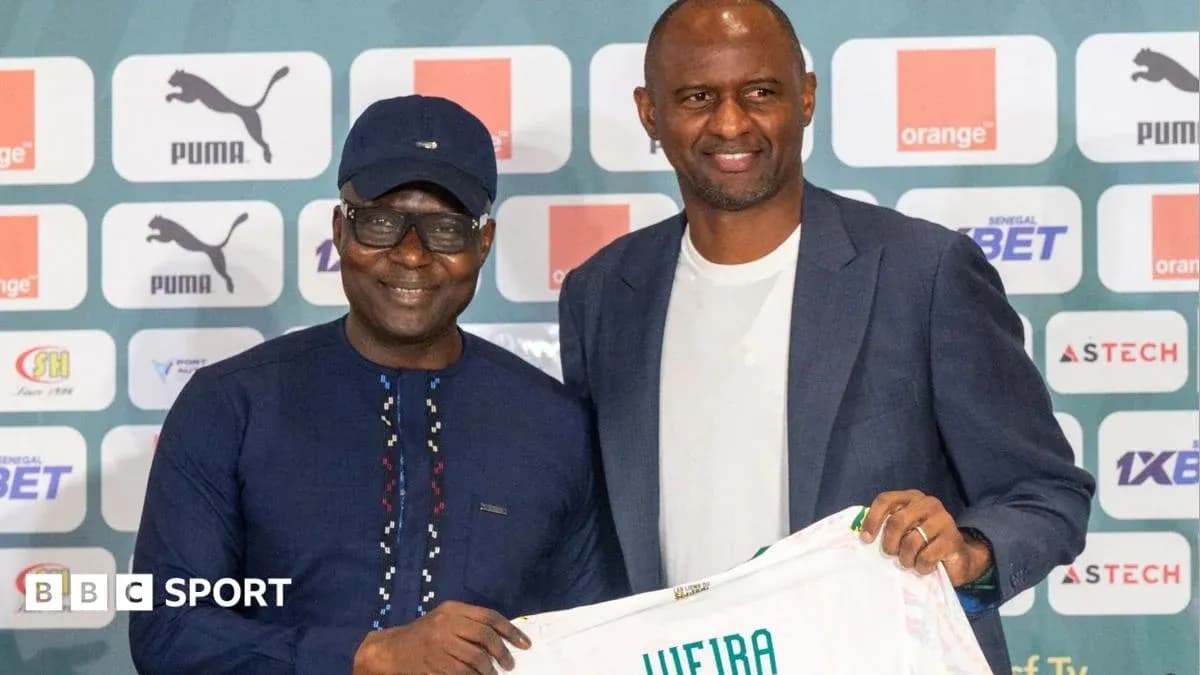
Patrick Vieira leans into the microphone, Senegal flag pinned to his chest, and does not bother hiding what this means.
“Being head coach of the Senegal national team is an absolute dream,” he says in Dakar. “I was born here, my parents were born here, and it really is a homecoming.”
For once, the cliché fits. This is not just another job for a coach on the carousel. For Vieira, 50 years old and forged in France’s greatest generation, this is a return to where it all began.
A World Champion Comes Home
Vieira left Senegal as a child and grew into a giant of the European game. World Cup winner in 1998. European champion in 2000. Midfield enforcer and leader of Arsène Wenger’s great Arsenal sides. His football identity was written in blue, white and red.
Yet the pull of green, yellow and red never faded.
He calls the decision to accept Senegal’s offer “one from the heart” and talks of “immense pride” as he steps into his first international job. The Teranga Lions did not chase a name for the sake of it; they turned to a native son who understands both the streets of Dakar and the pressure of global expectation.
From the first conversations with the Senegalese federation president, Vieira says, he did not hesitate.
“I accepted this challenge straight away, because there was also an exceptional generation of players,” he explains. “I realise the expectations of the people – all 20 million Senegalese. And I know that with the experience I have, with the determination I have, I’ll be able to see this project through.”
A Giant With Scars
This is not a rebuild from rubble. Vieira takes over a heavyweight.
Senegal are African champions on the pitch, even if the trophy currently sits elsewhere. They won the 2025 Africa Cup of Nations with a 1-0 extra-time victory over Morocco in January, only to be dragged into a legal storm months later. A walk-off by some Senegal players and staff in protest at a penalty decision in the final led to the trophy being handed to hosts Morocco in March. The Court of Arbitration for Sport will now decide where the title truly belongs.
On the global stage, the wounds are fresher. At the 2026 World Cup, Senegal led Belgium 2-0 after 85 minutes in the last 32 and still contrived to lose 3-2 after extra time. A golden chance to reach the latter stages slipped through their fingers.
Vieira knows he is inheriting a team that has already pushed the ceiling up.
“Today, Senegal is among the major nations in world football,” he says. “Senegal’s objectives aren’t what they were 10 or 15 years ago. On the back of its recent results, Senegal has moved forward, has reached new levels. The demand for results has also stepped up. We need to lay solid foundations.”
The pressure is no longer to compete. It is to win, regularly.
Not a Revolution, a Continuation
Vieira’s message is clear: this is not about ripping up what came before.
“What matters to me isn’t starting again from scratch,” he insists. “It’s about respecting what the federation has put in place over the last few years and building the next stage, opening a new chapter.
“A new chapter meaning my job isn’t to tear everything down, it isn’t to throw everything out of the window. It’s about keeping this team’s strength: its identity, its unity, its ability to suffer together.”
He wants a side with “a very precise structure” and a game built on “intensity and aggression”. The words are familiar from his club career, but here they sit on top of a strong national identity that predates him.
To make it work, he says, he needs more than just a squad.
“To make this project work, I’ll need the whole nation united. I’ll work heart and soul to restore the team’s pride.”
Thrown Straight Into the Fire
There is no gentle warm-up. No friendly at home to ease into the tracksuit.
Vieira steps in after the dismissal of Pape Thiaw and goes straight into qualifiers for the 2027 Afcon. Two fixtures in this international window, two more in November, and the final rounds in March 2027. The calendar does not wait for anyone, even a World Cup winner.
His reign was supposed to start with a home match against Mozambique on 25 September. Instead, Dakar is busy preparing for the 2026 Youth Olympic Games, and the game has been flipped. The first step of this “homecoming” will be away from home.
“Of course, I’d have preferred to play the first match here in Dakar,” Vieira admits. “But unfortunately, with the federation, we all felt the best decision was to postpone the match and go and play in Mozambique. Those are difficulties we’re going to accept and deal with.”
From there, Senegal head to Ethiopia for another away test on 29 September. Two games, two trips, and a new coach who barely has time to learn names on the training pitch before points are at stake.
Big Names Missing, Big Decisions Early
The squad he takes on the road is not at full strength.
Long-time number one Edouard Mendy, 34, has retired from international duty. The gloves pass on, and with them a layer of experience that has anchored Senegal’s rise.
Sadio Mané, the talisman of this era, will not be there either. Vieira says the 34-year-old is out with “a bit of a physical issue”. Given previous speculation that Mané might follow Mendy into retirement, that absence could have sparked alarm. Vieira moves quickly to shut that down, insisting the former Liverpool and Bayern Munich forward will “surely” be part of his next selection, if fit.
Right-back Krepin Diatta misses out because he is currently without a club. Ismaila Sarr is also absent, having yet to feature for Crystal Palace this season amid transfer rumours and a groin problem.
So the new coach starts with a thinner cast than he might have hoped, forced to test depth and character immediately.
A Coach Shaped by Setbacks
Vieira’s playing career was gilded with trophies. His coaching path has been far more rugged.
New York City, Nice, Crystal Palace, Strasbourg, Genoa: the journey has been long, the success uneven. He left Palace in March 2023 with 22 wins from 74 games in all competitions. He kept Genoa in Serie A in 2024-25, only to be sacked the following November after six defeats in nine league matches with the club bottom of the table.
He does not run from that record. He mines it.
“I’ve always been someone who stays positive,” he says. “That means you learn, and there are always positive things to take from it. I’m a better coach today than I was in my last spell at Genoa, because that experience helped me grow and made me realise certain things.
“Given the experience I have as a manager, I’ve got no doubt about my ability to meet the expectations of fans.”
In other words, the setbacks have hardened him. Senegal are not getting the elegant midfielder of old; they are getting a coach who has already been burned and believes he knows how not to repeat the same mistakes.
A Capital’s Embrace
If there were any doubts about how this appointment would land, Dakar answered them before he even reached the podium.
Vieira arrived on Thursday evening to a throng of fans at the airport. Videos on social media showed him holding a Senegal flag high, swallowed up by outstretched hands and phones, smiling his way through the crush.
“I couldn’t have been given a warmer welcome,” he says. “I saw the supporters’ enthusiasm and I thank them for it. Taking charge of this national team isn’t just a new stage in my career – it’s coming back home.”
The embrace is real. The expectations are even more so.
Senegal sit among the continent’s elite, their ambitions fixed on Afcon titles and deep World Cup runs. They have a coach who knows what it is to stand on the biggest stage and win. Now he must prove he can guide a nation, not just marshal a midfield.
The homecoming is complete. The hard part starts in Maputo.