.svg&w=384&q=75 "logo")
José Mourinho's Strategic Patience with Diomande
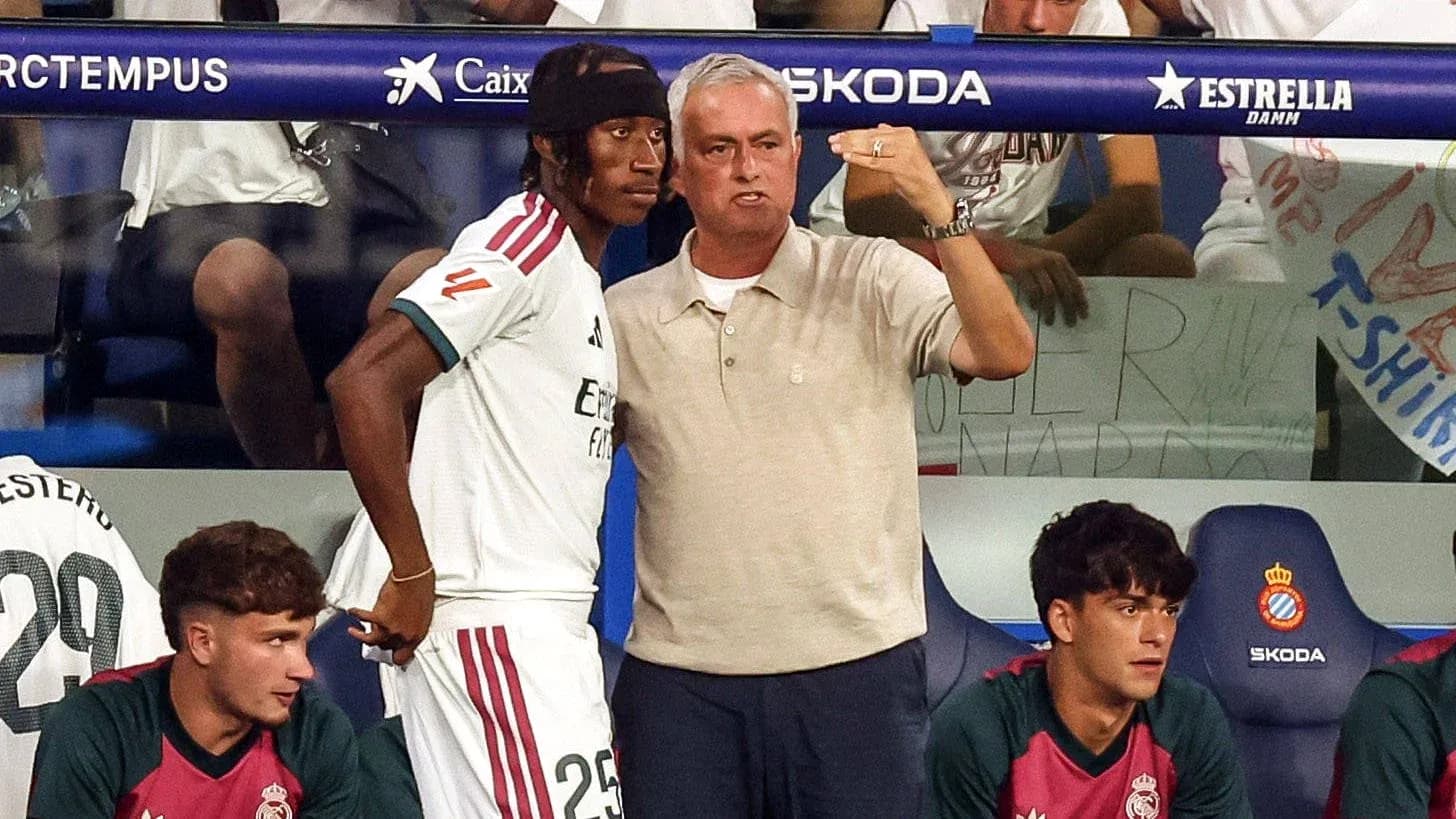
José Mourinho is playing the long game with his Ivorian forward, and he’s doing it with the cold precision of a coach who has seen careers made and broken by impatience.
He isn’t rushing him. He isn’t throwing him into the spotlight just to justify a transfer. Mourinho is giving him something far more valuable at a club of this size: time.
- Time to adapt.
- Time to understand the demands.
- Time to belong.
At the same moment, he’s sending a clear message to the rest of the dressing room. Arda Guler and Brahim Diaz, who both produced an outstanding pre-season and have built up credit over the years, are not being pushed aside for the new arrival. Their work, their patience, their performances still matter. Hierarchy, in Mourinho’s world, is earned, not bought.
That balance has not always been respected by others. Xabi Alonso, for instance, tilted the scales too quickly. He built his attack around the new sensation Mastantuono, nudging aside Rodrygo, Diaz and even Vinicius. The gamble backfired. The Argentine was talented but not yet ready to carry that kind of responsibility week after week. He burned out. The dressing room, sensing the unfairness and the instability, slipped away from Alonso’s control.
Mourinho has taken note of that cautionary tale.
His approach with Diomande is the opposite. The plan is protective, almost surgical. The Ivorian will be fed minutes, not flooded with them. Cameos, then longer spells, then starts—if his adaptation continues on track. The idea is simple: when he finally reaches the starting XI, he arrives there as a fully integrated piece, not a rushed experiment.
The real work is being done far from the cameras. Training sessions have become Mourinho’s laboratory. Diomande is being drilled on movements, pressing triggers, combinations, the small details that turn an individual talent into a functional weapon within the team’s structure. Mourinho is investing hours there, not for show, but to hardwire the system into his new forward.
Crucially, the player has bought into it.
There is no sulking, no restlessness, no public agitation over game time. Diomande trusts the process and the coach behind it. He trains, he listens, he smiles. That matters, because this is not some untested youngster clinging to his first chance. This is a forward with serious pedigree.
Last season, he played in 33 of Leipzig’s 34 Bundesliga matches, starting 28 of them. He finished with 12 goals and 8 assists. Those are the numbers of a man used to responsibility, used to being on the pitch when it counts.
Now, he’s learning to wait.
Mourinho is betting that this patience, this careful build-up, will pay off when the season reaches its sharpest edges—when legs are heavy, pressure is suffocating, and only the players who truly understand the system can carry a team through.