.svg&w=384&q=75 "logo")
Mourinho's Most Beautiful Defeat: Inter vs Barcelona
On 28 April 2010, the Camp Nou staged a defeat José Mourinho would later cherish more than many of his victories. He called it “the most beautiful defeat of his life”, a “historic miracle”. For once, the scoreline barely scratched the surface of the story.
Inter Milan arrived in Barcelona with a 3-1 advantage from the first leg of their Champions League semi-final against the reigning champions, a Barcelona side widely tipped to sweep them aside. Eight days earlier, Pep Guardiola’s team had been stung in Milan. Now, back in Catalonia, they were expected to put things right.
Instead, they ran into Mourinho at his most ruthless.
His plan was brutally simple: stop Lionel Messi, survive the storm, kill the rhythm of the game. Inter’s shape tightened, the lines compressed, every passing lane around Messi clogged with dark blue shirts. It was not pretty. It was not meant to be.
The task became even more daunting when Thiago Motta saw red, leaving Inter a man down for an hour. Barcelona had the ball, the territory, the noise. Inter had a lead, a manager who relished this kind of siege, and a squad willing to suffer for him.
Barca finally broke through, but only once. A 1-0 win on the night was not enough. Over two legs, Inter’s 3-2 aggregate triumph felt like a heist in plain sight, executed in front of a furious Camp Nou.
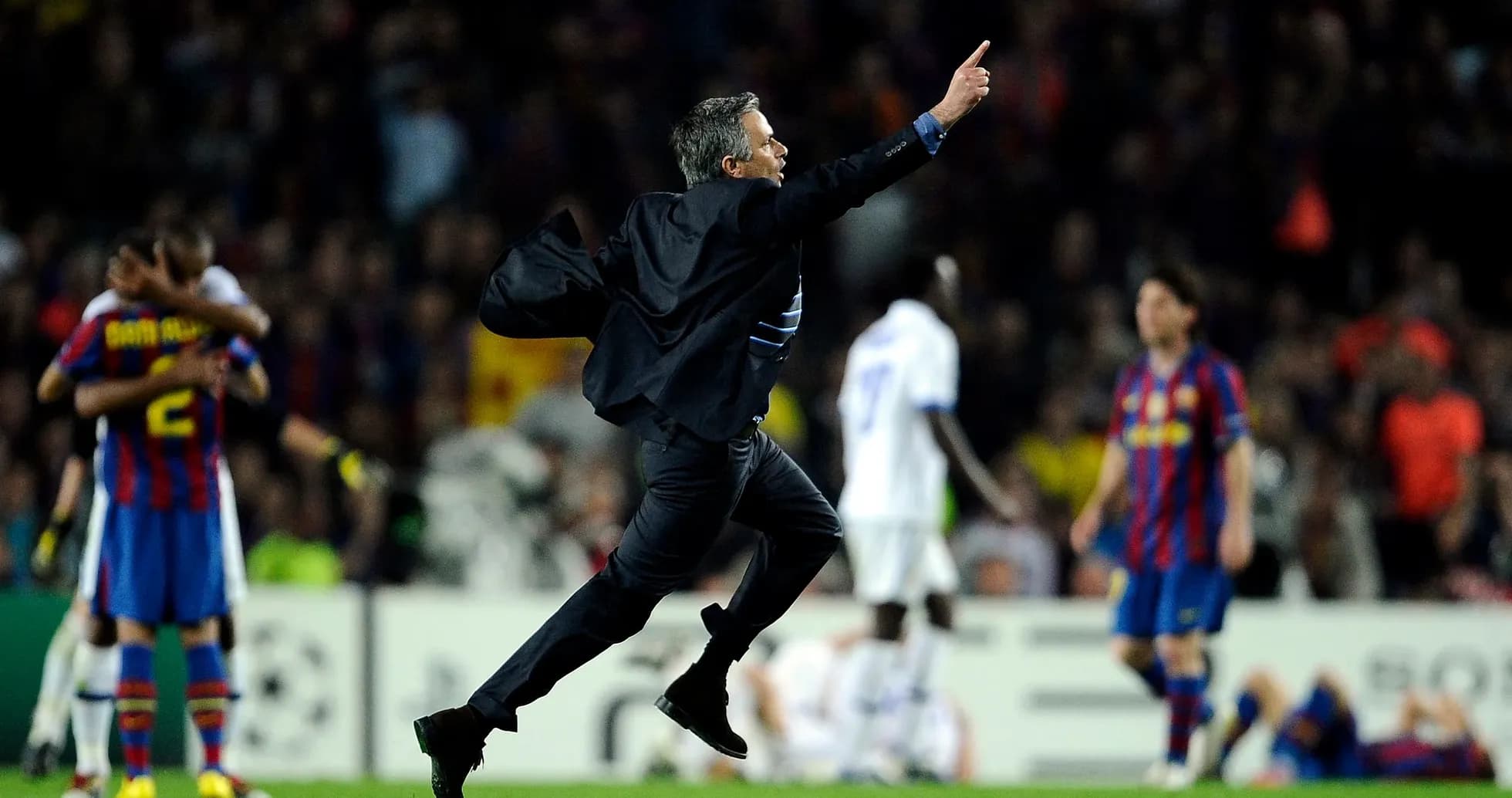
The final whistle unleashed Mourinho.
Index finger raised, he sprinted onto the pitch, straight through the chaos, celebrating with his players in front of a stadium that could hardly believe what it had just witnessed. The image became part of Champions League folklore: Mourinho charging across enemy territory, defiant and unbowed.
Some in Catalonia did not take kindly to it. As Inter’s players and staff continued their on-field party, the Camp Nou sprinklers suddenly burst into life, soaking the visitors. If the intention was to wash them away, it only added to the mythology of the night: Mourinho’s Inter, drenched and delirious, dancing in the rain on Barcelona’s turf.
Weeks later, they finished the job. A 2-0 win over Louis van Gaal’s Bayern Munich in the final sealed the treble and confirmed Inter as champions of Europe. That night in Madrid belonged to Diego Milito and a disciplined, relentless Inter side, but its roots lay in the resistance they had staged in Barcelona.
Mission impossible? Mission accomplished.
Years later, that phrase resurfaced in a different setting. In Madrid, a reporter, Tancredi Palmeri, recorded himself on his phone, half-joking, half-determined.
“The mission is very difficult. It is almost impossible to present Mourinho with a gift here,” he said. “It is difficult, but we will try.”
They did. And it worked. Mourinho, often portrayed as prickly in such environments, accepted the gift, smiled, shook Palmeri’s hand and walked out of the press room in good spirits. A small moment, but a reminder that the same man who once taunted the Camp Nou crowd can still be disarmed by a simple gesture.
Now, the story loops back on itself.
On Tuesday, Mourinho’s current club, Real Madrid, meet his former club, Inter, on the opening matchday of the new Champions League league phase. The narrative writes itself: the coach who conquered Europe with Inter but never quite managed to lift the trophy with Real in his first spell now stands between them again.
He left Milan for Madrid in 2010, riding the wave of that treble, and stayed until 2013. This summer, he returned to Spain’s record champions, a second act at a club where domestic success once came without the European crown he craved.
Inter gave Mourinho his greatest European night and his “most beautiful defeat”. Real Madrid gave him power, pressure, and unfinished business.
Now they share a pitch again. The question is simple: will this be just another group-stage meeting, or the opening chapter of Mourinho’s next “historic miracle”?