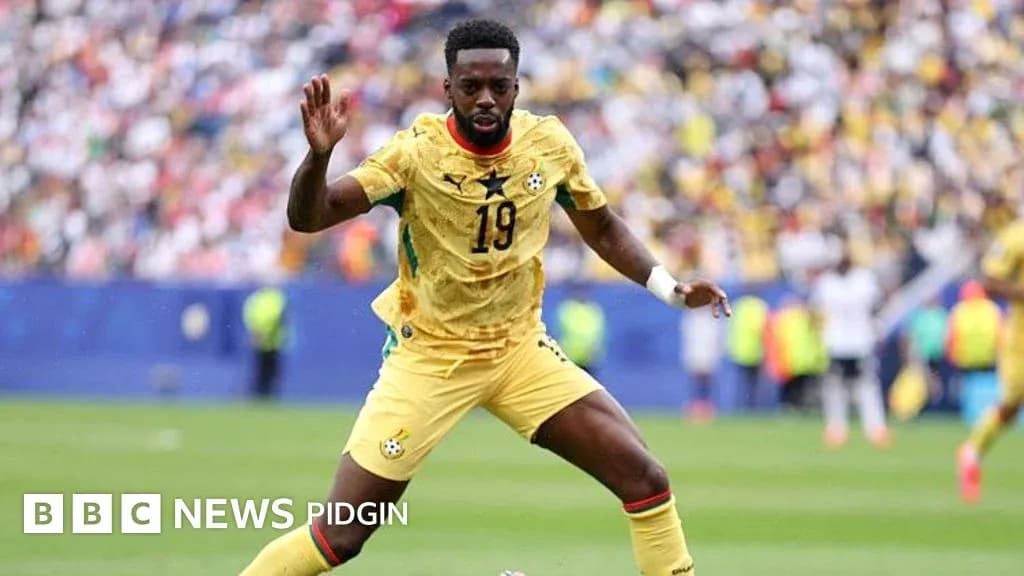
Inaki Williams Retires from Ghana National Team After World Cup
Inaki Williams has drawn a firm line under his international career with Ghana, announcing his retirement from the Black Stars after the 2026 Fifa World Cup.
The Athletic Bilbao forward revealed his decision on Friday, 11 September 2026, posting a heartfelt message on his X page. There was no ambiguity, no half-measures – just the conviction of a player who feels his work is done.
“I feel the time has come to bring my journey with the Ghana national team to an end. I leave happy, proud and with the peace of mind of knowing I gave everything every time I wore this shirt,” Williams wrote.
He walks away with that peace, but also from a World Cup that left Ghana with a sting.
World Cup disappointment as final chapter
Williams featured for the Black Stars at the 2026 Fifa World Cup, a campaign that promised more than it ultimately delivered. Ghana arrived in the knockout phase buoyed by strong group-stage performances against Panama and England, where they kept two clean sheets and looked organised, confident, and difficult to break down.
Then came Colombia.
A 1–0 defeat, narrow on the scoreboard but heavy in consequence, ended Ghana’s run and closed Williams’ final tournament with the national team. The exit cut short the optimism that had built around the side, and it now doubles as the last image of Williams in Ghanaian colours.
From Spain hopeful to Black Stars mainstay
Williams first declared for Ghana in 2022, ahead of the 2022 Fifa World Cup, after years of being seen as a potential Spain international. He had represented Spain at under-21 level, receiving his first call-up in March 2015, but never made a major competitive appearance for the senior side.
For a long time, the choice seemed settled. In 2021, when asked about playing for Ghana, he underlined how deeply rooted he felt in Spain, saying his parents were from Accra but that his culture was in Spain.
Then came the turn.
On 5 July 2022, Williams announced he would represent Ghana, embracing the Black Stars and the opportunity to wear the flag of his parents’ homeland on the biggest stage.
“Ghana has given me a lot, more than football,” he reflected in his farewell message. “It has allowed me to come back home, feel even closer to my roots and experience the enormous pride of representing my country and wearing this flag on my chest.”
That sense of belonging, once distant, had become central.
A journey shaped by roots and resilience
Williams’ story has always carried more weight than goals and appearances. Born in Spain to Ghanaian parents who crossed the Sahara desert on foot and jumped the Melilla border fence to seek a new life, he grew up with a family history marked by risk, sacrifice and resilience.
Football became his path. At 18, Athletic Bilbao spotted his talent and brought him into their youth setup. By 2014 he had made his La Liga debut for the first team, scoring his first goal the following February. From there, he evolved into a pillar of the club.
He did not just survive in the senior side; he thrived. Williams established himself as a key figure at Athletic, contributing to major victories and memorable moments, including a stunning long-range strike – a 20-metre goal – against Barcelona in the Spanish Super Cup final that underlined his big-game temperament.
In 2019, the club underlined their faith in him with a remarkable nine-year contract, one of the longest deals seen in modern football. Only the famous 10-year agreement Real Betis handed Brazilian winger Denilson in 1998 has stretched further.
Between two flags, choosing one heart
Internationally, Williams lived between two worlds for years. Spain had his formative football education; Ghana had his bloodline and family story. The choice was never simply tactical or opportunistic. It was emotional, cultural, and deeply personal.
Despite his early involvement with Spain’s under-21s, the door to the senior team never fully opened. Ghana’s call, once kept at arm’s length, became irresistible as he matured and looked back towards his roots.
By the time he pulled on the Black Stars shirt for the first time, the decision carried more than sporting weight. It was a homecoming, a public acknowledgement of where his story began.
Now, that chapter is closed. Williams has confirmed he will continue to support Ghana football and the Black Stars from afar, even as his own role shifts from protagonist to observer.
He leaves the national team as a player who did not just bridge continents, but identities. The next question is not what he gave to Ghana – that is clear in his words and his effort – but how the Black Stars will evolve without him as they chase the next World Cup, the next generation, and the next hero to carry the flag on their chest.