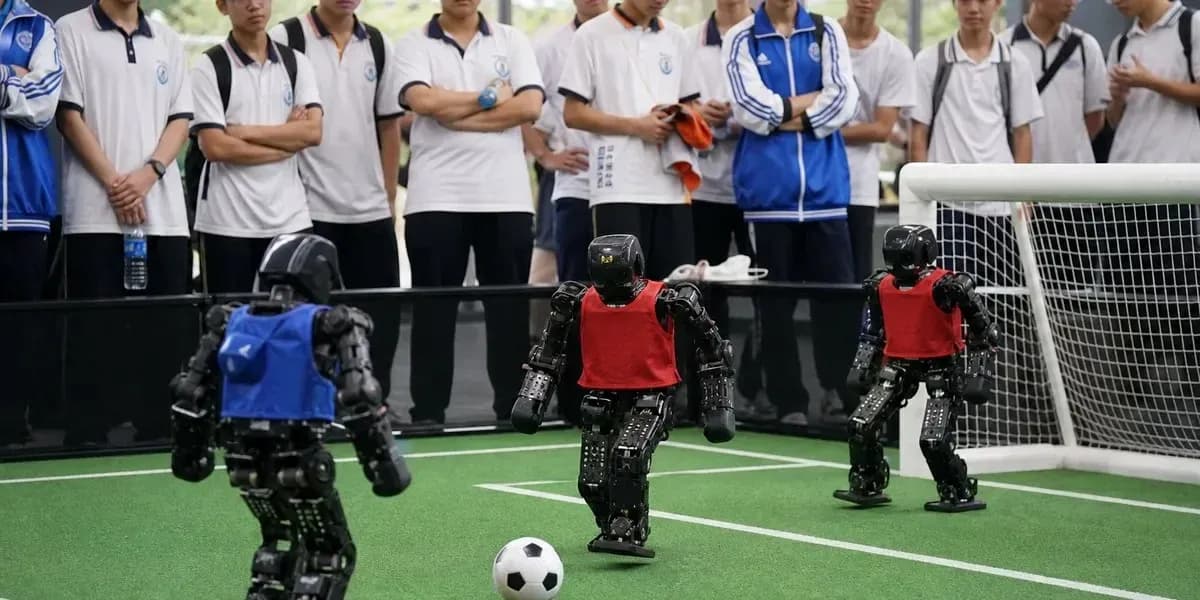
Humanoid Robot Football Carnival Launches in Nanning
The whistle went in Nanning on Thursday, and football took a bold step into a different era.
China’s southern city, capital of the Guangxi Zhuang Autonomous Region, is staging the first humanoid robot football carnival for secondary school students — a tournament where the players never tire, never cramp, and never once look to the bench for instructions.
More than 40 students from 10 secondary schools have converged on the event, but they’re not the ones chasing the ball. Their work happens on laptops and touchscreens. The running, turning, and shooting is left to Booster K1 humanoid robots, identical in appearance, but driven by very different brains: the artificial intelligence coded by the students themselves.
Three-on-three, no joysticks
The format is stripped-back and unforgiving: three-on-three matches, fully autonomous. No remote controls. No mid-game nudges. Once the robots step onto the pitch, the code takes over.
Each team fields three Booster K1 units, all relying on onboard sensors and pre-programmed decision-making to read the game. They track the ball, adjust positioning, and attempt to combine like any small-sided football team, only this time every pass, press, and misstep is a direct reflection of how well the students have taught their machines to think.
For Guangxi, organizers are calling it the largest and highest-level humanoid robot football event ever held for secondary school students in the region. For the kids on the touchline, it’s something else entirely: a live test of whether their algorithms can handle the chaos that every football match inevitably brings.
A new kind of showcase at the China-ASEAN Expo
This is not a standalone curiosity tucked away in a school gym. The carnival runs alongside the 23rd China-ASEAN Expo, which is taking place in Nanning from September 17 to 21, and it fits neatly into the expo’s broader message.
One of this year’s three main exhibition zones focuses squarely on artificial intelligence and cross-border exchanges in the field. Under the theme “CAFTA 3.0 Opportunities, Better Life,” the expo is pushing a vision in which technology reshapes daily living, trade, and education. The robot football carnival plays the role of a vivid, noisy, and occasionally clumsy illustration of that future.
Around the pitch, the program stretches beyond the matches themselves. There are scientific events that pull back the curtain on the tech, interactive demonstrations that let visitors get close to the robots, China-ASEAN exchanges that underline the regional dimension, and activities tailored for parents and children who might be watching AI football for the first time.
The result is a scene that feels part science fair, part football festival. On one side, students huddle to fine-tune their code. On the other, younger children watch in fascination as metal feet swing at a ball and sometimes, gloriously, connect.
The question now is simple: if this is what secondary school football carnivals look like in Guangxi today, what will the next generation of players — human and humanoid — bring to the pitch?