Harry Kane Breaks Bundesliga Record with 100 Goals in 98 Games
Harry Kane doesn’t just chase records anymore. He hunts them down, breaks them, and leaves them in the dust.
On a crisp afternoon at the Allianz Arena, the Bayern Munich striker added another line to a career already heavy with milestones, becoming the fastest player ever to reach 100 Bundesliga goals. He needed just 98 league appearances to do it. Nobody has ever got there quicker.
A Penalty, a Roar, a Record
The moment itself was almost routine, which somehow made it even more striking.
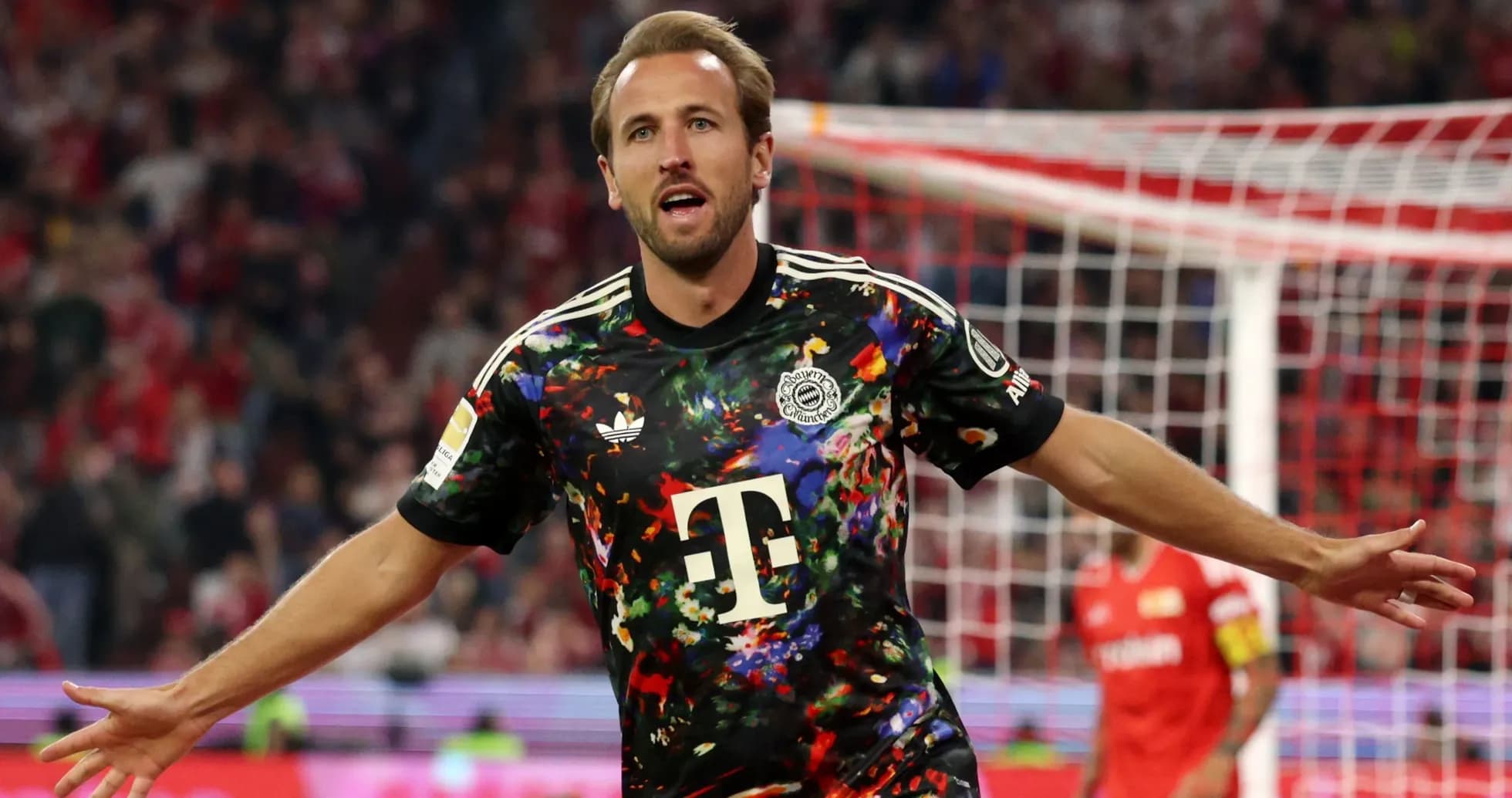
Thirty‑nine minutes on the clock against Union Berlin. Michael Olise bursts into the box, is clipped, and the referee points to the spot. No debate, no delay. The ball is placed on the spot and, as so often in Munich now, there is only one man who is going to take it.
Kane stepped up, shoulders square, eyes fixed. One clean strike. Clinical. The net rippled, the Allianz roared, and the scoreboard ticked over to a number that will sit in Bundesliga history: 100.
A simple penalty. A seismic landmark.
That goal pushed him beyond a record that had stood since the 1970s, when Dieter Müller needed 129 games for Cologne to reach the same tally. Kane has sliced more than an entire season’s worth of matches off that benchmark.
Numbers That Bend Belief
The raw figures behind his start in Germany look almost unreal.
Since arriving from Tottenham Hotspur in the summer of 2023, Kane has scored at a rate of a goal every 78.5 minutes in the Bundesliga. Not per game. Per 78.5 minutes. For a striker already known for his relentlessness in England, he has found an even sharper edge in Bavaria.
Put that in context.
Erling Haaland, the reference point for modern penalty‑box devastation, averaged a goal every 87 minutes during his spell at Borussia Dortmund. Robert Lewandowski, who made scoring in this league feel like a weekly obligation, sat at roughly every 100 minutes. Gerd Müller, the man whose name is woven into the fabric of German goalscoring folklore, averaged one every 105.
Kane has undercut them all.
This is not a hot streak stretched over a few months. It has been sustained across seasons. He hit 36 goals in his first Bundesliga campaign, followed that with 26 in 2024‑25, then 35 more last season. Different coaches, different title races, same outcome: Kane on the scoresheet, Bayern on the march.
Bayern’s Relentless Centrepiece
For Bayern, his reliability has become the spine of their domestic power.
His goals have underpinned back‑to‑back league titles in 2024‑25 and 2025‑26, the kind of dominance the club expects but can never truly take for granted. When the attack has stuttered, Kane has been the reset button. When games have drifted, he has supplied the jolt.
The club’s reaction to his latest milestone told its own story. No long tribute video, no elaborate caption. Just a stark, almost defiant message on their official channels: “𝟏𝟎𝟎 𝐁𝐮𝐧𝐝𝐞𝐬𝐥𝐢𝐠𝐚 𝐠𝐨𝐚𝐥𝐬.”
They didn’t need to dress it up. The number did all the talking.
Across all competitions, his output borders on the absurd: 151 goals in 154 appearances for Bayern. At this pace, the conversation is no longer whether he will reach 200 for the club, but how soon into his contract cycle he might get there.
A Record‑Breaker Across Europe
This is not an isolated German phenomenon. Kane has been re‑writing the record books across the continent since he left north London.
Earlier in his Bayern stint, he became the fastest player in history to score 100 goals for a single club in Europe’s top five leagues in the 21st century, hitting that mark in just 104 competitive games. That put him ahead of Cristiano Ronaldo’s blistering start at Real Madrid and Haaland’s explosive opening years at Manchester City, both of whom needed 105 matches.
Different leagues, different systems, different eras of superclubs. Kane keeps finding a way to sit on top of the pile.
Country, Club, and a Career Recast
The transformation of his narrative has been just as striking as the numbers.
For years at Tottenham, he was the great goalscorer without the great trophies, a striker whose personal excellence outstripped his team’s return. In Munich, that tension has eased. The medals have started to arrive, and his individual records now come attached to collective success.
On the international stage, his authority is just as clear. Kane remains England’s all‑time leading scorer and recently pushed his tally to 70 goals during the 2026 World Cup. He is no longer just the focal point of England’s attack; he is the statistical reference point for every forward who will follow.
So here he stands: 100 Bundesliga goals in 98 games, a goalscoring rhythm that has bent long‑standing records out of shape and redefined what a late‑career move can look like for an elite striker.
The question now is not whether he will keep scoring. It’s how many more records the Bayern No 9 can realistically tear down before this extraordinary chapter in Germany finally closes.