.svg&w=384&q=75 "logo")
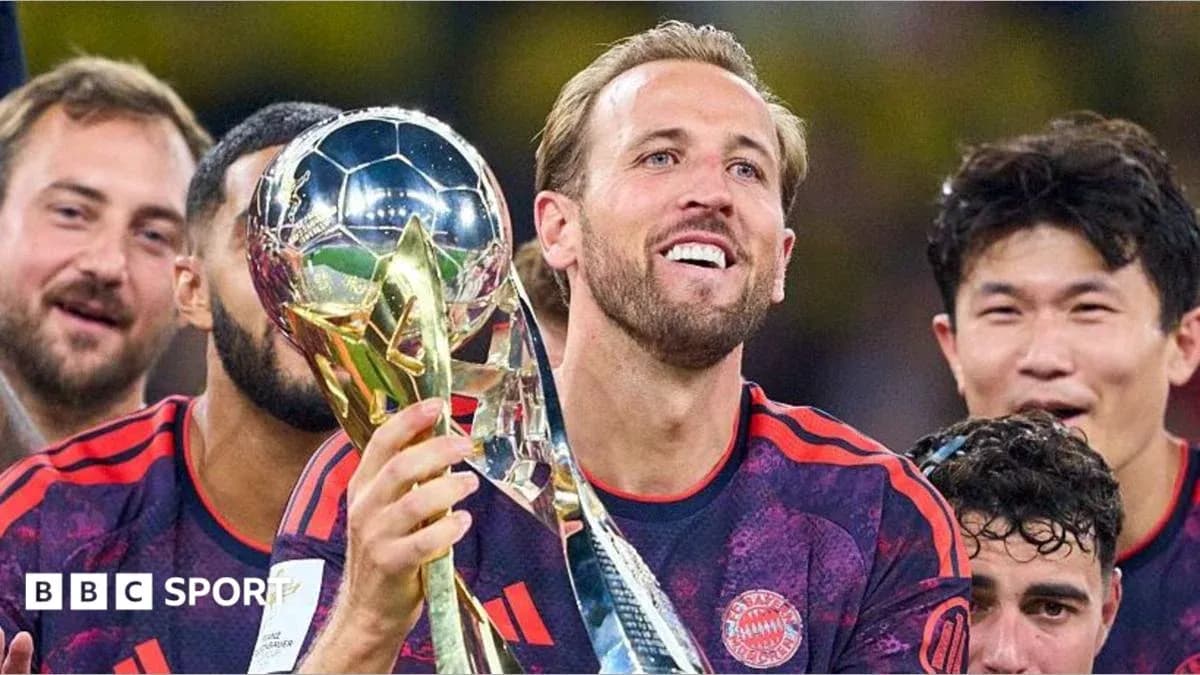
Harry Kane Leads English Charge in 70th Ballon d'Or
Harry Kane stands where every forward dreams of standing: at the front of a Ballon d'Or shortlist, framed as the man to beat.
The Bayern Munich striker is one of three England internationals named among the 30 contenders for the 2026 award, and this time the narrative bends around him. Real Madrid’s Jude Bellingham and Arsenal’s Declan Rice join him on the list, but it is Kane who goes in tagged as the favourite, the emblem of a generation that has spent a decade trying to break football’s most exclusive ceiling.
Across the Atlantic, the old master refuses to step quietly off the stage.
Lionel Messi, now with Inter Miami and now 39, appears again. Another year, another nomination, another tilt at history. He is chasing a ninth Ballon d'Or, an absurd number that already feels like a record from another sport. His latest case is built on one last monumental international push: eight goals as Argentina fought their way to the World Cup final in July, only to fall to Spain. He walked away from international football after that, but not before leaving one more deep imprint on the game’s biggest stage.
Spain, the team that denied him, now flood the list.
Six members of their World Cup-winning squad are included, a reflection of a side that combined youth, control and ruthless timing. At the heart of that wave sits Lamine Yamal, the prodigy who has become the face of a new era almost before his childhood has finished. His presence on this shortlist feels less like a surprise and more like a confirmation: the future is arriving early.
And then there is the man who decided the final.
Ferran Torres, scorer of the winning goal in that World Cup showpiece, also makes the cut. His summer move from Barcelona to Paris St-Germain already looked like a step into a bigger spotlight; a Ballon d'Or nomination underlines just how quickly he has embraced it.
PSG, still fresh from back-to-back Champions League triumphs, dominate the field.
Nine of their players are nominated, not counting new signing Torres. The French champions have turned European nights into a habit, and awards season now reflects that power. Last year’s winner, Ousmane Dembele, returns to the list, his name sitting there like a reminder that the Ballon d'Or is no longer just about the traditional giants of Spain and England. Paris have forced their way into the conversation and refuse to leave.
Real Madrid, of course, never drift far from this stage.
Kylian Mbappe and Vinicius Jr are both shortlisted, two forwards who play the game at a different speed and with a different edge. They represent the club’s latest attacking axis, the next chapter in a lineage that runs from Di Stefano to Ronaldo and beyond.
From north London, Arsenal’s rise takes on another layer of validation.
Defenders Gabriel and William Saliba both make the 30-man list, a nod to a back line that has turned the Emirates into one of Europe’s most unforgiving away trips. For a club that has spent years trying to reassert itself among the elite, seeing two centre-backs named alongside the game’s biggest stars tells its own story.
All of it feeds into a landmark year for the award itself.
The Ballon d'Or turns 70. Born in 1956 under the banner of France Football, it has tracked the sport’s evolution from muddy pitches and heavy leather balls to global superbrands and billion-euro squads. This time, the winner will be crowned in London on 26 October, a deliberate, loaded choice of venue.
It is a salute to Sir Stanley Matthews, the former England winger who won the very first Ballon d'Or.
From Matthews in 1956 to Kane, Bellingham and Rice in 2026, the circle closes in the city that helped define the game. The question now is whether, on a night built to honour its past, English football finally sees one of its own lift the most coveted individual prize of them all again.