.svg&w=384&q=75 "logo")
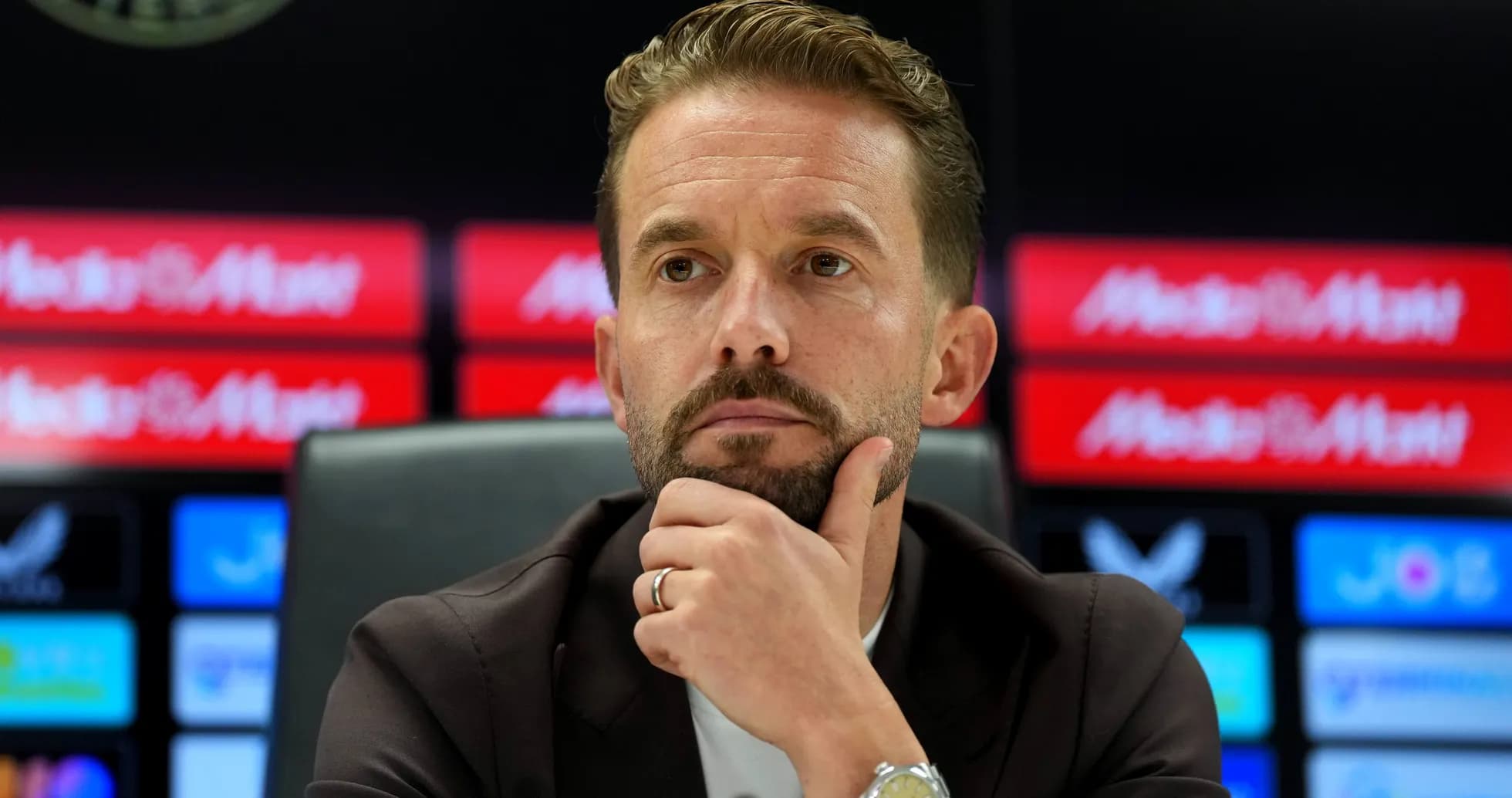
Feyenoord’s New Technical Director Faces Criticism
Dévy Rigaux has barely closed his first transfer window at Feyenoord and already the knives are out. On De Telegraaf’s Kick-off podcast, Valentijn Driessen and Mike Verweij dismantled the club’s new technical director with a ferocity that leaves little room for doubt: they do not trust his course, nor his communication.
According to them, his debut summer in Rotterdam has been “no success at all.” The criticism goes deeper than a few questionable signings. It is about attitude, realism and the way he positions himself in relation to his predecessor, Dennis te Kloese.
“I fear the worst”
Verweij’s alarm bells started ringing during Rigaux’s recent round-table session with journalists. That performance, he says, reminded him uncomfortably of a name that still makes Ajax supporters wince.
“When I look at that round-table discussion by Rigaux with several journalists, I really fear the worst,” Verweij said, drawing a direct line to Amsterdam. “I hope this does not become the new Sven Mislintat.”
The comparison is not casual. Verweij paints a picture of a technical director who talks big, leans on rules and formalities, but seems detached from how the market actually works.
Rigaux had stated that “no club is allowed to talk to Hadj Moussa, because he has an ongoing contract.” For Verweij, that sounded hopelessly innocent.
“That is very naive, because it happens everywhere,” he argued, pointing to the reality of modern transfer dealings, where informal contacts and early talks are the norm rather than the exception.
The Read bid and the numbers game
The podcast then moved to the case of Read, another flashpoint in the criticism. Rigaux had insisted there was no €30 million offer, instead referring to an “official bid” of €26 million.
Verweij is unimpressed by that distinction. He claims that in telephone contact, Roma immediately indicated they were prepared to move towards that €30 million figure. In his eyes, Rigaux is hiding behind semantics, playing with the word “official” to frame the story in his favour.
The pattern, Verweij suggests, is worryingly familiar. “He brings in players from the second Bundesliga,” he noted, again echoing the Mislintat era at Ajax, where a string of signings from Germany failed to deliver.
And it is not only the transfer policy that triggers déjà vu. “Another similarity is that you can sense in the media that everyone is over the moon with Rigaux, as if a world wonder has walked in. That was also the case with Mislintat.”
The warning is clear: hype can be a dangerous shield.
Driessen: “A scandalous round-table”
If Verweij’s tone is sharp, Driessen’s is outright explosive. He calls Rigaux’s media appearance “truly a scandalous round-table discussion” and zooms in on the way the Belgian spoke about the Te Kloese period.
According to Driessen, Rigaux did not attack his predecessor head-on, but “let all kinds of things slip” about what he found at the club: too many players, wages too high, too many write-downs. The subtext, in Driessen’s reading, is obvious: Rigaux wants to underline the mess he inherited.
For Driessen, that does not wash. “He knew what he was getting into, didn’t he?” he snapped, pointing out that Feyenoord’s recent sporting results under Te Kloese hardly suggest a disaster.
His irritation grows when Rigaux speaks of working in a “completely different way” than the former technical boss. “Well, I’m very curious whether in that, according to him, ‘completely different way’ he is going to achieve the same results as Dennis te Kloese,” Driessen said.
Then comes the sporting warning shot. Driessen believes the current squad, shaped in part under Rigaux’s first window, is not built to compete in Europe at the level Feyenoord aspires to.
“You can go into the Champions League with this team,” he said, “but you will finish bottom without a chance. And then what is the value of Read, Hadj Moussa and Zechiël?”
The question cuts straight to the heart of any transfer policy: not just the fee, but the platform on which those players can shine.
“Everyone falls for his slick talk”
Verweij returns one more time to the Mislintat parallel. For him, the danger is not only in the signings or the numbers, but in the way a charismatic technical director can charm his surroundings.
“Everyone falls for his slick talk!” he exclaimed, before taking aim at one specific claim that raised eyebrows: the suggestion that goalkeeper Tjark Ernst is material for Die Mannschaft.
That, for Verweij, is a step too far. Hyperbole instead of sober analysis. “Every diagonal ball is a goal conceded!” he said, reducing the grand projection to a painful image of vulnerability at the back.
The message from the podcast is unmistakable. In their eyes, Feyenoord have entrusted a crucial phase of their sporting project to a man who talks convincingly, challenges the recent past and leans on technicalities, but has yet to prove he can build a squad that stands up to Champions League scrutiny.
The season will reveal whether Rigaux’s “completely different way” is visionary or reckless. For now, in the Dutch media arena, he is already playing from behind.