.svg&w=384&q=75 "logo")
Champions League 2023: PSG's Three-Peat Challenge
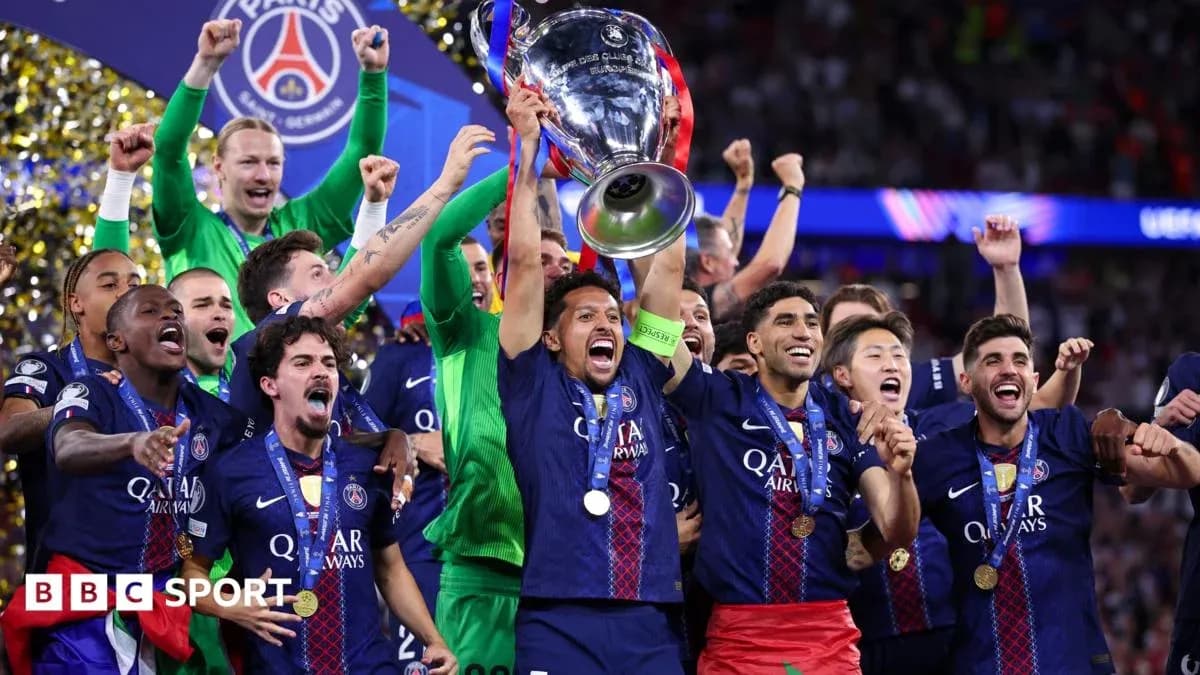
The Champions League anthem is about to roll around Europe again, and on 5 June in Madrid one club will lift the trophy that now feels almost reserved for Paris St-Germain. Almost.
PSG are chasing a historic three‑peat as the new league phase kicks off on Tuesday. No side has managed that since the Cristiano Ronaldo-era Real Madrid, and that comparison hangs over this campaign. Two in a row is rare air. Three in a row is the stuff of dynasties.
Julien Laurens is blunt: he doesn’t see it happening.
Arsenal, Bayern and the end of a PSG monopoly?
Laurens expects PSG to go deep again – “at least the semi-final” – but draws the line at a third straight crown. The physical and mental strain of staying at the summit, the tiny margins in knockout football, the fact they do not have Ronaldo’s guaranteed chaos in the box – it all adds up.
So who breaks the French grip?
For Laurens, the final is Bayern Munich v Arsenal. Two clubs who, he argues, have consistently merited a place on this stage over the past two seasons and now look primed to cash in.
Arsenal are his pick to win it. Not because of romance or narrative, but because of something far more brutal: their defence. Laurens calls it the best in Europe “by far”, and he leans on a timeless European truth – the tightest back line usually walks away with the trophy. In his projected podium, PSG make the last four, Bayern fall just short, and Arsenal finally climb the last step after last year’s runners-up finish.
Across the Channel, five English clubs are loading up to stop PSG’s run, but it’s Mikel Arteta’s side that carries the weight of expectation. Arsenal have learned how to win regularly; that habit, as Guillem Balague notes, has stripped away tension and given their key players a new freedom. It shows.
PSG’s strain, Barcelona’s surge
Balague looks at PSG and sees both fragility and menace. The French champions have started the season in fits and bursts, the cost of trying to live at the cutting edge of modern football. Luis Enrique demands constant movement, relentless pressing, risk with the ball. It’s thrilling when it works and erratic when it doesn’t.
The league phase, in Balague’s eyes, becomes a laboratory. A place to experiment, to suffer the odd strange result, to sharpen the system for when the competition hardens after January. The spine is still there. The belief is that, once the noise settles, PSG will again be right on the brink of another title.
But Barcelona are charging.
Under Hansi Flick, Barça are “flying”, even as they search for the final pieces – another centre-back and a true number nine. Those were the reinforcements Flick wanted to push the project to its next level, yet he already sees a team climbing fast. The style is front-foot, the press is high and aggressive, and the squad looks built to hurt teams in this new, expanded league phase.
Balague groups Barça with PSG and Arsenal as the three sides that should populate the semi-finals, barring an early collision in the draw. The final spot? That, he says, will likely come from Bayern Munich, Real Madrid or Manchester City, again depending on how the bracket falls.
Five players to shape Europe
Individual brilliance will, as always, tilt tight ties. Laurens singles out five names he expects to leave a mark.
At Real Madrid, Jude Bellingham faces a pivotal season. Now operating as a number 10 under Jose Mourinho, he stands at the centre of Madrid’s rebuild. The role suits him: late runs, goals, responsibility. After a strong World Cup, Laurens expects that momentum to carry into Europe – more goals, more decisive nights, more of the aura that already surrounds him.
In Italy, Como step into the Champions League for the first time, and their heartbeat is Nico Paz. Wearing the number 10, he drives everything Cesc Fabregas’s side do with the ball. Fabregas has built a team that wants the ball, wants to entertain, and Paz is the creative engine. Still “very much in the making”, as Laurens puts it, but heading rapidly towards the elite.
Then there is “Mr Champions League” himself in this PSG era: Khvicha Kvaratskhelia. For two seasons he has terrorised defences from the left, cutting inside, darting outside, shooting with either foot. He scores spectacular goals, glides past markers, and drags spectators to the edge of their seats. Laurens believes he is firmly in the Ballon d’Or conversation.
Lens, back in the Champions League after pushing PSG all the way in Ligue 1, bring one of the most coveted young defenders in Europe: Ismaelo Ganiou. At 21, he is quick, powerful, composed on the ball and already the cornerstone of their back line. Laurens fully expects a Premier League giant to come calling at the end of the season.
Completing his list is Donyell Malen. Since leaving Aston Villa for Roma, the Dutch forward has exploded, scoring at close to a goal a game as the lone striker in Gian Piero Gasperini’s high-octane system. Roma’s return to the Champions League brings back a club that thrives on big European nights, and Laurens anticipates Malen rediscovering his very best level on this stage.
Kane’s mission, Yamal’s rise and Kvaratskhelia’s ceiling
Balague’s spotlight falls on another five.
At Bayern Munich, Harry Kane has set his sights on the Ballon d’Or. His numbers and influence already justify the ambition, and Balague sees no reason for a drop-off. Bayern’s style – structured possession, waves of attacks, a stream of service into the box – plays directly into Kane’s strengths. If Bayern go far, his campaign for the individual prize will only grow louder.
In Barcelona, Lamine Yamal is chasing his own European breakthrough. Still a teenager, he has already shown a hunger that belies his age, and the Champions League is his next target. Flick’s insistence on a high, passionate press opens up the pitch for Yamal to attack space and defenders. The stage feels made for him.
Back in Paris, Balague agrees with Laurens on Kvaratskhelia: there is another level to come. As PSG advance, he expects the Georgian to keep rescuing them in big moments, deciding tight games almost single-handedly. In Balague’s eyes, it is only a matter of time before Kvaratskhelia claims a Ballon d’Or.
Shakhtar Donetsk, long renowned for turning Brazilian talents into major European transfers, may have found their next jewel in Kaua Elias. At 20, he already fits the club’s tradition: flair, technique, and the potential to command a huge fee once he matures on this platform.
And at Arsenal, Martin Odegaard looks ready to reclaim full control. Last season’s injuries disrupted his rhythm, but he has started this campaign sharply. Balague sees a player capable of dictating games and a team now confident enough to lean on his leadership. If Arsenal are to turn promise into silverware, Odegaard will have to own these nights.
Fabregas’ Como, Europe’s outsiders and the long road ahead
Beyond the giants and the Ballon d’Or contenders, the new format opens the door to fresh stories.
Balague is fascinated by what Fabregas is building at Como. The former Spain midfielder has turned down tempting offers to stay with the club and refine his ideas. There is a freedom about his work there: room to experiment, room to fail, room to push tactical concepts without the suffocating pressure of an elite superclub. He has, as Balague puts it, swum against the tide and now finds himself right at the front of modern thinking. The expectation is clear – Como should have enough to reach the knockout stages.
Elsewhere, LASK arrive after knocking out Celtic, a statement of their competitive edge. Their realistic target? A home win, a respectable points tally, and a first campaign they can build on. Qualification looks unlikely, but they have already shown they will not be overawed.
Sabah, from Azerbaijan, face a brutal schedule: trips to Arsenal and Manchester United, home dates with Barcelona and Borussia Dortmund. Their success is built on organisation and structure, and that discipline should earn them one or two eye-catching results. Across a full league phase, though, the mountain may simply be too steep.
Then there is Viking. Drawn against Bayern, Atletico Madrid, Napoli and Aston Villa, they walk into a group that would intimidate most. Yet Norwegian football has quietly become a breeding ground for sharp coaches and clever, resilient teams. Balague believes that intelligence and competitiveness could carry Viking into the knockouts.
So the stage is set. PSG hunt history, Arsenal smell their moment, Barcelona and Bayern circle, Real Madrid and Manchester City lurk in the shadows. New faces, new ideas, old obsessions.
On 5 June in Madrid, will the familiar anthem end with a familiar champion – or the birth of something entirely new?