Bournemouth's Historic European Win Against Real Sociedad
“From -17 to Europe,” read the flag in the away end at Anoeta. Four words, held high in the Basque rain, telling a story that still feels barely believable.
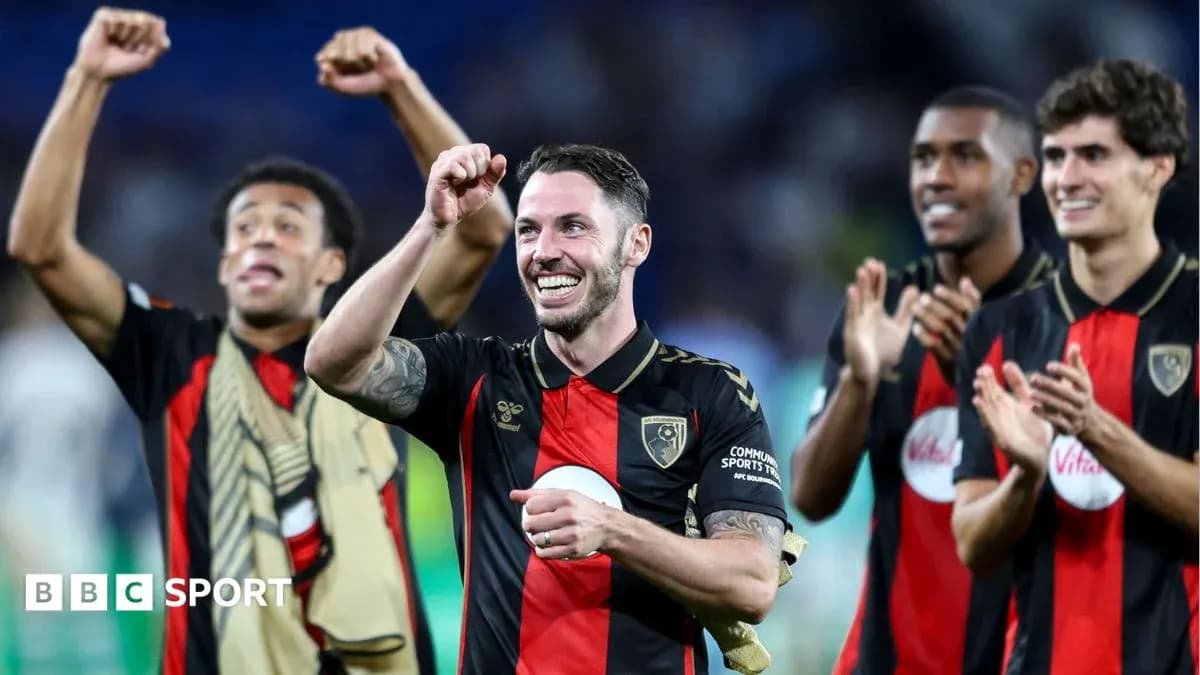
On a night when Bournemouth finally stepped into Europe, 127 years after the club was formed, they did more than make up the numbers. They went to Real Sociedad, stared down a Copa del Rey-winning side led by World Cup winner Mikel Oyarzabal, and won 2-1. A proper European away win. No caveats.
“It’s a brilliant win in our first European game. It’s brilliant for the club and the 2,000 fans from Bournemouth,” Marco Rose told TNT Sports, his voice cutting through the noise as the travelling support refused to leave their corner of San Sebastian.
From the brink to the big time
To understand the scale of this, you have to go back to the days when Bournemouth were just trying to stay alive, not chase Spanish scalps.
Eighteen years ago the club was on its knees. Administration, a 10-point deduction, relegation to League Two. Then came the ultimatum: accept a 17-point deduction just to stay in the Football League for 2008-09 and agree not to appeal, or risk oblivion. They took the punishment. Survival, not Europe, was the dream.
Those who sat through cold afternoons in front of four-figure crowds could not have imagined this: a £100m-rated midfielder dictating a Europa League tie, clipping passes into a Brazil winger with a £130m release clause, the pair combining to win a game in Spain.
Yet here was Alex Scott, striding around Anoeta with the swagger of a player who knows half the Premier League is watching, and Rayan showing precisely why Bournemouth will demand every last penny if anyone comes calling.
A first half to stun San Sebastian
Bournemouth did not creep into Europe. They arrived with intent.
For 45 minutes they smothered Sociedad. Rose’s side hunted in packs, pinning the hosts in and repeatedly winning the ball high up the pitch. This was not the plucky English underdog clinging on; this was an away side imposing itself in a notoriously hostile arena.
They pressed, they snapped into tackles, they passed with composure even when Sociedad’s defence was set. Every regained ball seemed to spark another wave, another half-chance, another nervous shuffle in the home stands. The Cherries looked like they had been doing this for years.
Sociedad had been poor, but nobody in blue and white was under any illusions. There is a steel to this Basque team and a trophy in the cabinet from last season to prove it. A reaction was coming.
Suffering, and surviving
After the interval, it arrived.
The adrenaline that had fuelled Bournemouth’s first-half dominance began to ebb. Passes lost a yard of zip. The press, so ferocious early on, dropped half a step. The game tilted.
Rose saw it too. “It was very intense and tough,” he admitted. “Brilliant first half in everything. The way we won balls and the possession high up. In the second half, we needed to suffer because we were not so sharp.”
The suffering came. Sociedad pushed higher, Oyarzabal found pockets of space, and memories flickered of Bournemouth’s early-season habit of letting leads slip in the Premier League. This is not a club traditionally associated with gritted-teeth defending and backs-to-the-wall resilience.
But this time they held.
Djordje Petrovic stood tall when it mattered, his sharp reflexes bailing out a tiring back line. Clearances no longer carried the same precision but they carried conviction, and that was enough. Every block, every header, every punched cross in the closing stages fed the belief that this was their night.
When the whistle went, it confirmed more than a win. It confirmed that Bournemouth can play European football on European terms.
Howe’s legacy, Smith’s moment
None of this happens without Eddie Howe.
His appointment in January 2009, with Bournemouth drowning under that 17-point handicap, changed everything. He kept them up, finishing nine points clear of the drop when they had started the season effectively three defeats behind everyone else. Six and a half years later, in his second spell, he had taken them to the Premier League.
The line from that escape act to Anoeta is not straight, but it is unbroken.
So it felt fitting that, on this latest landmark night, the team was led out by a survivor from those early days of the climb. Adam Smith first arrived on loan in 2010-11, returned permanently in 2014, and has been there ever since, closing in on 400 league appearances.
“Adam has been with the club for so long,” former Cherries full-back Charlie Daniels told BBC Radio Solent. “Dedicated himself to the club, and it’s such a proud moment, not only for him, but for his family, his team-mates and old team-mates to see how he’s grown – not only as a player but as a man as well. To lead out the Cherries on this historical night is fantastic.”
Smith wrote his own piece of history too. At 35 years and 141 days, he became the oldest English outfielder to make his debut in major European competition since Ipswich’s Reginald Pickett in 1962. A stat that underlines just how unusual this story is.
No academy conveyor belt, no gilded path through Champions League nights. Just a loyal servant, a club captain, and a stage he once had no right to expect.
The good times, with a warning
Even in the modern era, Bournemouth’s rise has rarely been smooth. Relegation in 2020, the slog of coming back, the constant challenge of seeing key players picked off by richer clubs. Every summer seems to bring another rebuild.
This year was no different. Not even European qualification could keep Andoni Iraola, who returns to the Vitality Stadium with Liverpool on Sunday. The pattern is familiar: Bournemouth develop, bigger clubs circle, the cycle begins again.
It will not stop. The market will not suddenly take pity on a club from the south coast.
But nights like this change the equation. They give supporters something else, something bigger, than transfer sagas and managerial churn. They offer a glimpse of what Bournemouth can be, not just what they might lose.
In San Sebastian, under the lights, with that flag unfurled – “From -17 to Europe” – the journey felt complete and unfinished all at once.
The question now is not whether Bournemouth belong on nights like this. It is how often they can make them happen.