.svg&w=384&q=75 "logo")
Borussia Dortmund vs Hoffenheim: A Clash of Ideas
Borussia Dortmund’s transfer business is done. The window has closed, the noise has faded, and what’s left is the part that really matters: the football.
Six points from six in competitive action so far – a Bundesliga win over Hamburg and safe passage in the cup against HEBC – have eased them into the campaign. Now comes the first serious examination of Niko Kovac’s new-look side: a trip to Hoffenheim.
Hoffenheim’s revival and a summer of change
Hoffenheim arrive as more than just an awkward early-season opponent. Under Christian Ilzer, they have quietly turned into one of the league’s sharper outfits. He walked into a relegation battle in 24/25, dragged the club to safety, then doubled their points haul last season. They finished just a point shy of the Champions League spots. That stings in Sinsheim – and it fuels this season.
The squad, though, has shifted. Bazoumana Toure, the winger who gave them direct running and chaos in wide areas, has gone. Fisnik Asllani’s move to RB Leipzig collapsed on medical grounds and he remains sidelined through injury. The plan to cash in and reshape the attack stalled before it even started.
So Hoffenheim pivoted. Patrick Wimmer arrived from Wolfsburg to replace Toure’s dynamism on the flank. Two of the most eye-catching names in the Bundesliga followed: Mats Rots and Nathan De Cat. Rots offers promise, De Cat brings energy and bite. The Belgian is expected to slot into midfield alongside Wouter Burger, whose own name will raise as many smiles as eyebrows on a teamsheet.
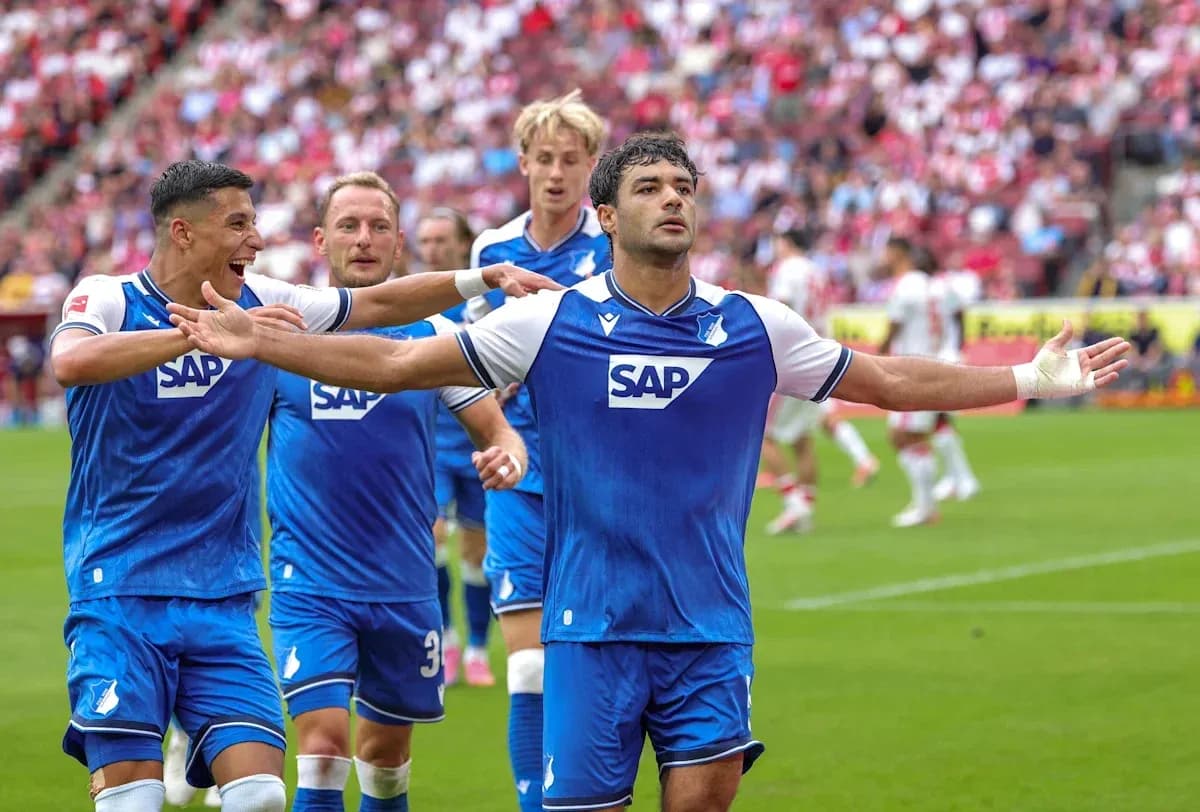
Only Wimmer featured in the 2–3 opening-day defeat at Köln, a game in which Hoffenheim had plenty of the ball but not enough control in key moments. Ilzer is unlikely to let that stand. The starting XI should look different against Dortmund, and with Asllani still unavailable, the attacking responsibility will be spread across a reshuffled cast.
A clash of ideas in midfield
For Dortmund, the questions start with the lineup and run straight through to identity.
Kostas Konstantelias’ ACL injury and Samuele Inacio’s suspension have ripped out one of the connections behind Serhou Guirassy. Kovac needs a new partner for Karetsas in the two attacking midfield roles. Marcel Sabitzer, Carney Chukwuemeka and new signing Ethan Nwaneri all offer solutions. Sabitzer, with his experience and tactical discipline, feels the most natural fit, especially away to a side that wants to dominate the ball.
That leads to the second, more intriguing issue: how Dortmund will actually play here.
Against both Hamburg clubs, they dictated tempo and territory. Across those two games, they out-shot their opponents 35–9, with a remarkable 20 efforts in the Bundesliga opener alone. They moved the ball with confidence, stepped high, and looked every inch a possession team.
Hoffenheim won’t let them have it all their own way. Last season, Ilzer’s side finished fourth in the league for possession, with Dortmund just behind in sixth. On the opening weekend, Hoffenheim saw 59% of the ball in Köln. They want the game on their terms, with the ball at their feet and the opposition chasing shadows.
So something has to give. Dortmund either go toe-to-toe in midfield, pressing high and trusting Nmecha and Bellingham to wrest control from Burger and De Cat, or they accept longer spells without the ball and look to turn fewer chances into sharper, more ruthless ones. For Kovac, this is the first real data point on what his Dortmund will be when they cannot simply steamroller the opposition.
The Kramaric problem
Lurking within all of this is a familiar threat.
Andrej Kramaric is 35 now, often used as a super-sub, yet his record against Dortmund remains chillingly current. In the club’s entire history, only five players have scored more goals against die Schwarzgelben. Four of those names sit inside the Bundesliga’s all-time top ten scorers. The other is 15th. That is the company Kramaric keeps when Dortmund are on the other side of the halfway line.
Eighteen games. Eleven goals. Two of them came in this exact fixture last season.
He may not start. He may only get half an hour. But if the game is tight and Dortmund’s back three begin to tire, the Croatian stepping off the bench with space to work in and a point to prove is precisely the scenario Kovac will want to avoid.
Kovac’s likely hand
After a brief experiment with a 4-3-3 against HEBC in midweek, the expectation is that Kovac returns to his preferred 3-4-2-1 for a tougher away assignment.
Gregor Kobel should come back in goal after Meyer’s cup outing. In front of him, Gadou, Anton and Ryerson form the back three, tasked with dealing not just with Hoffenheim’s movement but their rotations between the lines.
Out wide, Svensson and Beier are set to operate as wing-backs, required to sprint the length of the pitch: pinning back Wimmer and company one minute, doubling up defensively the next. Central midfield remains anchored by Nmecha and Bellingham, the trusted pair who set the rhythm and decide whether Dortmund can push or must absorb.
Ahead of them, Sabitzer is expected to step in for the injured Konstantelias, joining Karetsas in the pockets behind Guirassy. The striker, fresh from his goal last week, leads the line again, the reference point Dortmund will look for when they break Hoffenheim’s press or sling crosses in from advanced wing-back positions.
It’s a setup that can morph from controlled possession to rapid transition in a heartbeat. The question is whether it can do so against a side that refuses to surrender the ball.
Hoffenheim chasing a top-four push, Dortmund chasing proof that their early form is more than a soft launch. One of them will leave with a clearer idea of their ceiling.