Ancelotti vs Silva: Clash Over Brazil's Football Future
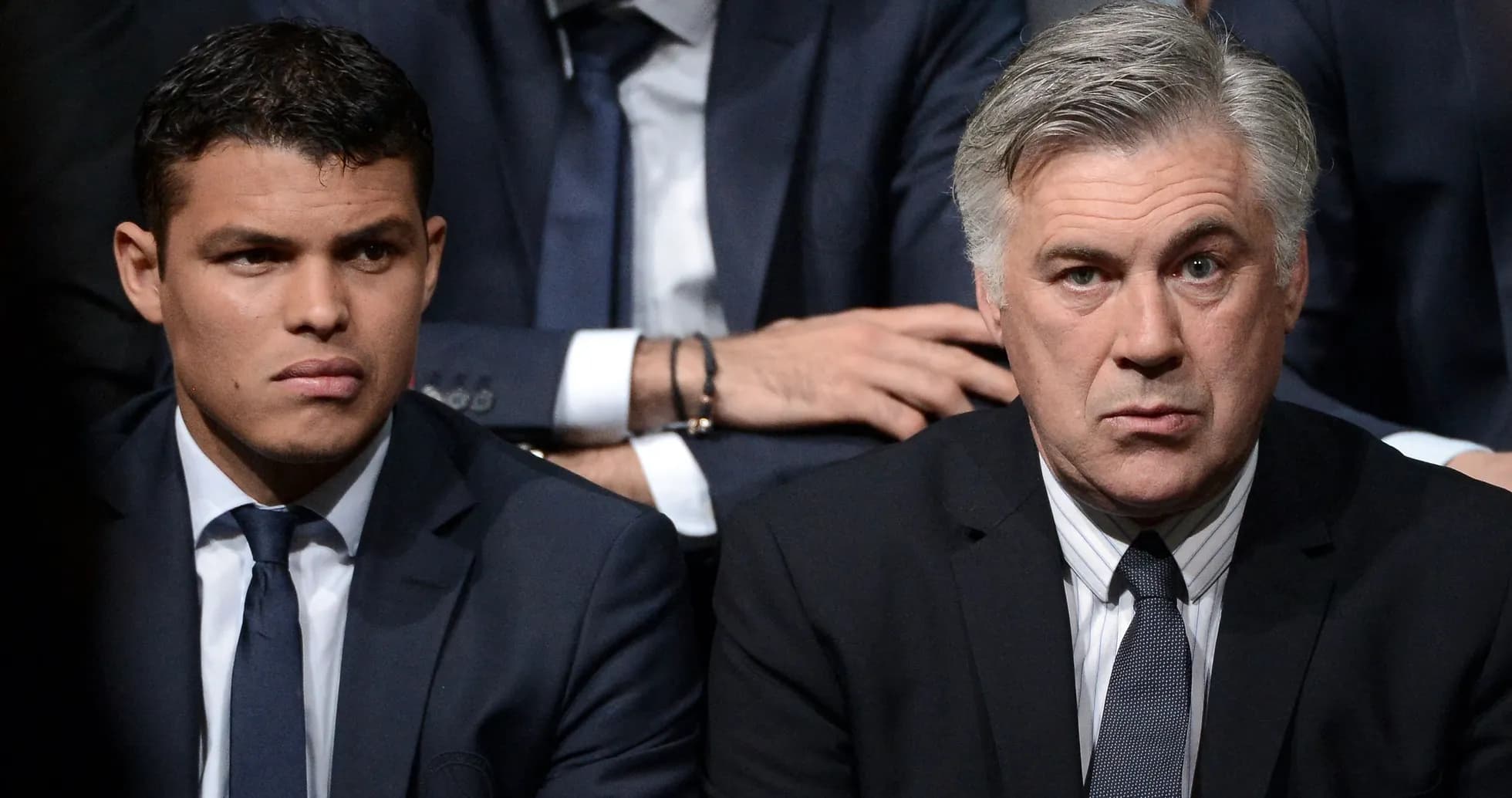
Carlo Ancelotti and Thiago Silva are on opposite sides of a fault line running straight through Brazilian football.
Once, they were perfectly aligned. In 2012-13 at Paris Saint-Germain, Ancelotti built his defence around Silva and famously called him “the best defender in the world.” Thirty-four games, one clear hierarchy. Coach and captain in lockstep.
That harmony has gone.
A Legend Left Out, And Unimpressed
The spark came with Ancelotti’s latest Brazil squad announcement: 26 players, ten of them based in the domestic league, several of them new faces, and a clear message that the national team is being rebuilt at pace after a last-16 World Cup exit.
Silva, 113 caps and one of the most decorated defenders of his generation, is nowhere near it. He was left out of the World Cup squad despite a strong loan spell at FC Porto and has now watched a new Brazil take shape without him.
He did not stay quiet.
Speaking to Radio Tupi after Fluminense’s Copa Libertadores win over Platense, Silva challenged the very foundation of Ancelotti’s plan.
“Do you want me to lie or tell the truth? You can't rule out players who are 31, 32 or 33,” he said, cutting straight to the point. For him, international football is not a lab for sweeping experiments; it is a place where change has to be handled with care.
“In the Brazilian national team, things have to be done step by step. You can't just get rid of everyone and bring in new players.”
Then came the sharper jab, aimed at Ancelotti’s background and methods.
“He comes from European football, where it's easier to make changes. It doesn't work like that here. I don't agree with it, but he's the one in charge.”
The message was clear: Brazil, in Silva’s eyes, cannot be rebuilt like a club side. Tradition, hierarchy, and experience still matter.
Ancelotti Stands His Ground
Ancelotti did not let the comments hang in the air.
Facing the media at CBF headquarters in Rio, the Brazil coach was asked directly about Silva’s criticism. His first response was ice-cold.
“I don’t look,” he said, brushing away the noise before outlining his thinking for the upcoming friendlies against Australia and India.
For Ancelotti, these games are about testing the future, not clinging to the past. He insisted the squad list is “balanced,” and made one principle very clear: age, by itself, will not close the door on anyone.
“I don't generally look at players' age. Right now, the priority is young players. But if a 34 or 35-year-old is prepared to play in an important competition, he will be in the national team.”
It was both a defence and a challenge. The door remains open for veterans, he argued, but they must fit into a team that is moving forward, not holding its breath for one more tournament with the old guard.
A New Wave, With Familiar Stars
The squad list underlines his intent.
Ten uncapped players under 30 have been called up for the first time. In goal, Hugo Souza, Pedro Morisco and Otavio headline the new wave. At the back, Arthur Dias, Jair, Mauro Junior, Matheuzinho and Manchester City’s Vitor Reis are handed a chance to stake their claim.
In midfield, Breno Bidon and Gabriel Bontempo receive debut invitations, stepping into a group that still carries star power. Vinicius Junior, Endrick, Estevao and Raphinha remain the attacking reference points, the bridge between what Brazil already is and what Ancelotti wants it to become.
This is not a gentle tweak. It is a reset.
Silva’s argument is that such a reset should be phased in, with experienced figures guiding the next generation. Ancelotti’s answer is that the phase-in is happening now, in real time, on the pitch, with these friendlies serving as the testing ground.
Two Visions Of Brazil’s Future
Strip away the personal history and the disagreement is philosophical.
Silva sees the national team as an institution that must respect seniority, especially in a football culture as intense and unforgiving as Brazil’s. He believes that cutting loose too many veterans at once risks losing the competitive edge and emotional balance that only experience brings.
Ancelotti sees a squad that exited the World Cup in the last 16 and needs a jolt. Friendlies, in his view, are the moment to take risks, to see who can handle the shirt, to decide who will be ready when the next major tournament arrives. Reputation alone will not protect anyone.
The tension between those positions is now public. It involves a coach who once trusted Thiago Silva above almost all others, and a defender who feels the new Brazil is moving too fast without him and his generation.
Brazil will face Australia on September 25 and 29, then travel to Kolkata to meet India on October 3. By then, the debate will not be about words on a radio show or a press conference soundbite.
It will be about whether this new-look Brazil can convince on the pitch – and whether the old guard will ever truly be part of it again.