.svg&w=384&q=75 "logo")
Madring Circuit: Formula 1's New Car Killer
The new Madring circuit has not hosted a single Formula 1 session yet, and already it has a reputation. Not for glamour. Not for architecture. For wreckage.
“Car killer,” is how Williams team principal James Vowles put it after watching Formula 3’s first serious run at Madrid’s brand‑new venue. Nineteen red flags. Three broken chassis. Suspensions torn apart. A test that looked less like preparation and more like a warning.
This weekend, F1 walks straight into it.
A Street Circuit With Teeth
On paper, Madring sounds like another modern street track: walls, walls, and more walls. In reality, drivers who’ve sampled it talk about something very different.
A blend of Monaco, Macau and Jeddah. Old-school in attitude, unforgiving in detail. Corners that don’t open up and let you breathe, but chase you on exit. Barriers that don’t peel away, but stand their ground and wait.
Audi-backed F3 championship leader Freddie Slater captured the mood bluntly after that bruising test:
“The corners that are there, they're so tight and they're not forgiving and also the walls come at you on the exit of the corners. They don't go away from you like most tracks.”
You don’t ease into a rhythm here. You wrestle one out of the place.
Slater’s verdict? Brutal, but brilliant. In his view, one of the best tracks on the junior calendar, precisely because it feels like an echo of old UK circuits or Macau – fast, close, and merciless when you step a millimetre over the line.
And that’s the crux of Madring: to be quick, you must attack. To attack, you must flirt with the walls. To flirt with the walls, you must accept the risk of a very expensive afternoon.
For F1 teams operating under a tight cost cap and already juggling development budgets toward 2026, that is a chilling equation.
The Lap That Won’t Let Go
The Madring lap opens with a slow chicane, visually reminiscent of Jeddah’s early sequence, then fires the cars flat-out through Turns 3 and 4. It’s only a few corners in before the circuit bares its teeth.
The second chicane is the first true “car killer” zone. High speed. Kerbs that bite. A wall that looms on exit. This is where so many F3 cars ended up bent, broken, or both.
Slater explained why: it feeds an uphill section, and with it, a huge chunk of lap time.
That temptation pulls drivers in. Arrive at roughly 340km/h – one of only two straight‑mode zones on the lap – and the choice is stark. Commit and skim the wall for time, or back off and vanish down the order. Get the kerb strike slightly wrong and the trajectory is simple: head-first into concrete.
Forget the clean, almost arcade-style lines from early sim videos. The real thing is nastier, more jagged, and far less forgiving.
Survive that and the circuit dives under an underpass and climbs again through another complex that claimed its share of F3 victims. The headline corner, though, sits further round: La Monumental.
La Monumental: F1’s New Monster Corner
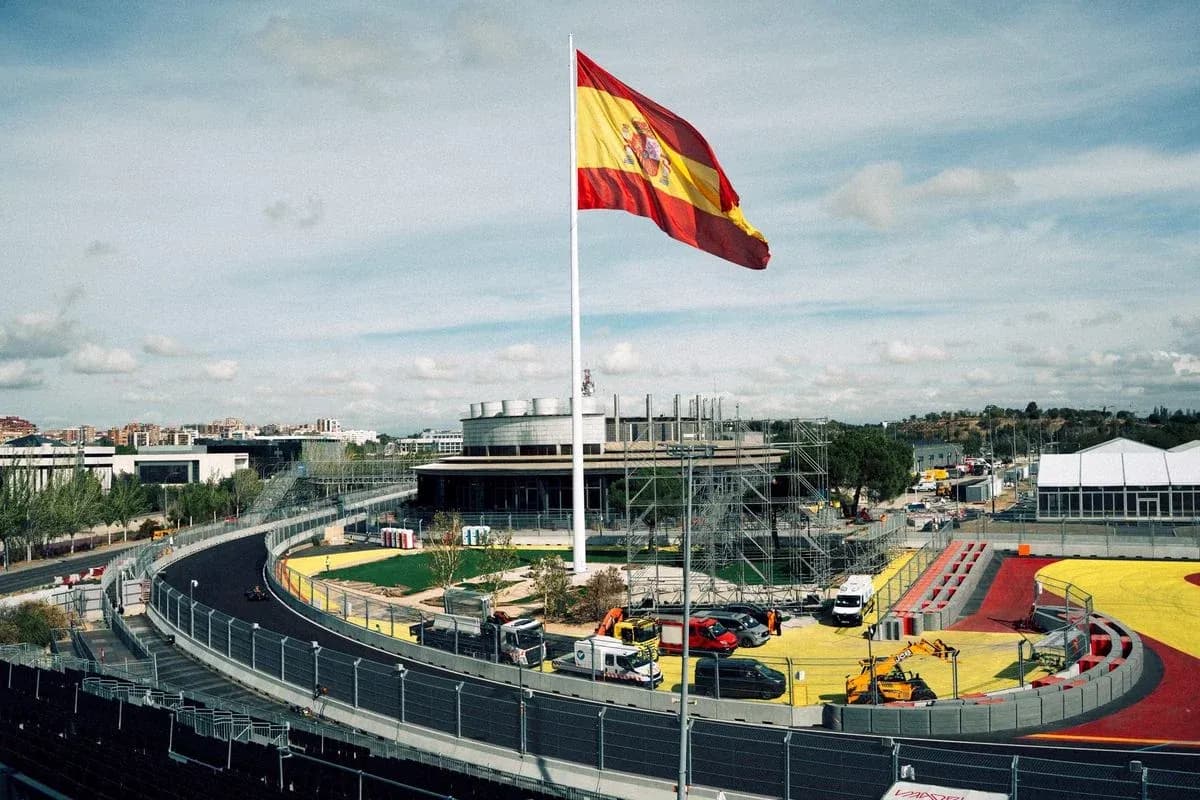
La Monumental is the showpiece – a 24% banked corner that makes Zandvoort’s banking look modest. It is not just a visual statement; it is a mechanical and physical one.
Pirelli’s chief engineer Simone Berra has called it “the most severe turn” on the calendar. His data suggests it loads the tyres 20–30% more than Zandvoort’s banked sections. That is a staggering jump.
The exit is blind. The corner is grip‑limited rather than power‑limited, so the tyres and suspension carry the burden. Bottoming can be brutal if you pick the wrong line over the crest. It looks simple from the outside. It isn’t.
“It feels like I'm in an IndyCar on an oval,” Slater said. In F3, it’s just about flat. In F2 and F1, with heavier, more powerful cars and vastly higher loads, the margin will shrink dramatically.
And remember: La Monumental is only halfway round the lap.
From there, the track just keeps coming. More technical sequences. More walls. Corners like the tight Turn 17 right-hander, where there is no real room to go conservative and still be competitive.
Monza F3 sprint winner Taito Kato summed up the trade-off: “If you want to gain laptime, you have to push until you’re close to the wall, so it’s risky but fun to drive.”
Risky and fun for drivers. Terrifying for team accountants.
Shock, Respect, and a Question of Danger
By the time the F1 paddock reached Monza, the whispers about Madrid had already started. On the drivers’ parade, Carlos Sainz admitted “everyone seemed quite shocked by the track that Madrid has come up with”.
Sainz, a Madrid GP ambassador, meant “shocked” in a positive sense: a calendar increasingly filled with wide, polished, slightly anonymous street layouts has suddenly acquired a circuit with real edge. Character, as he put it. Bite.
He knows, though, that F3’s test was chaotic. He expects F1’s first weekend to be busy for the marshals too, predicting safety cars, red flags, and yellow flags in qualifying.
Others are more matter-of-fact. Audi’s future F1 driver Gabriel Bortoleto called it “very interesting” and “dangerous” but also “very challenging” – a combination that most racing drivers secretly relish.
Sergio Perez, by contrast, cut through the drama. To him, Madring is “not any more dangerous than Jeddah”. That still leaves plenty of scope for big shunts. Jeddah has already produced some of the most violent crashes of the ground‑effect era, including Mick Schumacher’s 2022 qualifying wreck that ended his weekend on the spot.
So the question is not whether Madring is gentle. It isn’t. The question is whether it sits within a level of risk the sport now accepts.
What it clearly does offer is the chance for drivers to make a difference. The lap is technical, littered with low‑speed corners and sequences where confidence and precision trump horsepower. Red Bull junior Arvid Lindblad has already branded it “a real drivers’ track”.
That should set the stage for a qualifying session that feels like a high‑wire act: razor-thin margins, a real threat of a Monza‑style upset, and one tiny misjudgment punished with carbon fibre confetti.
Sunday, though, is another story.
Will the Race Deliver?
The same traits that promise a spectacular qualifying hour threaten to strangle the grand prix.
Tight corners. Very few meaningful straights. Almost no heavy braking zones. On paper, there are limited natural passing spots. The energy management profile suggests a race more like Hungary – strategic, positional, tense – than the attacking free‑for‑alls of Monza, Silverstone or Spa.
Alex Albon put it with a wry smile: “I don’t think there’s going to be any overtaking. I hope you guys got your fix in Monza and ignore next weekend.”
Chaos could still rip up the script. Safety cars, red flags, and restarts tend to unlock opportunities that the layout alone doesn’t offer. But there’s another variable in play: the support races.
F2 and F3 will pound round Madring all weekend, with five races between them and F3 deciding its title. The last time F1 arrived at a new, unforgiving street circuit with GP2/F2 as the undercard, Baku in 2016 descended into one of the wildest junior weekends in memory – 17 retirements across two races, accidents everywhere.
Faced with the wreckage, F1’s class of 2016 dialled it back on Sunday. The much‑hyped first Baku GP turned into a subdued, cautious affair. The chaos everyone expected only arrived in later years, once teams and drivers understood where they could push and where they couldn’t.
Sainz remembers that pattern well.
He believes F1 drivers are, by nature and necessity, more disciplined. They carry the responsibility of thousands of staff back at the factory and know the cost of a single mistake in a cost‑capped era. They also know that parts supplies can be tight late in a season. Crashing is not just painful; it is strategically disastrous.
He also sees a role for the grid in helping Madring evolve. One practice session might be enough to flag problem kerbs, awkward cambers, or areas that invite accidents for no good sporting reason. Drivers can feed that directly to the race director and the FIA, nudging the circuit away from needless jeopardy without stripping away its character.
Even so, with so many danger zones and so few escape roads, it feels inevitable that someone will be caught out this weekend – maybe in qualifying, maybe in the race, maybe in every session.
Madrid’s Audition
Sainz has urged his colleagues not to rush to judgment. He points to Miami, whose 2022 debut he described as “a bit of a disaster” before it settled into what he now calls a “great grand prix”. Circuits can be tuned. Lines can be refined. Kerbs can be reprofiled. The first weekend is rarely the finished article.
He also knows the stakes. Madrid has a 10‑year contract, but contracts don’t guarantee affection. With cities queuing up to host races, every new venue is effectively on trial from the moment the lights go out.
Madring has already passed one test: nobody is calling it bland.
Its old‑school aggression, its car‑killing kerbs, and that monstrous La Monumental banking should produce a qualifying session that grips the paddock and the grandstands alike.
Now comes the real examination. Can this snarling, unforgiving circuit also stage a grand prix worthy of its reputation, or will Sunday expose a track that only truly comes alive when there’s nothing at stake but one lap and sheer nerve?